
Apple fruit weevil
Tatianaerhynchites
Description
How to identify
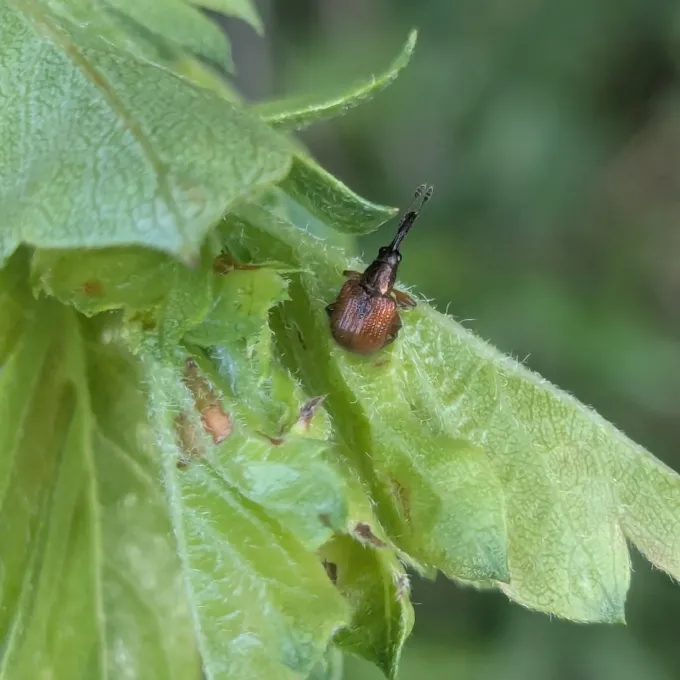
The apple fruit weevil (Tatianaerhynchites aequatus) belongs to the order Coleoptera and the family Rhynchitidae. It is a small beetle, with a body length ranging from 2.5 to 3.5 mm.
The coloration of the insect varies from copper-red to golden-purple, giving it a characteristic metallic sheen. The body is covered with sparse, short, and light-colored hairs.
The head of the beetle is elongated into a long tube called a rostrum, which terminates in a powerful chewing apparatus. The larva of the apple fruit weevil has a curved, white or cream-colored, legless body with a brown head, reaching 4–5 mm in length.
Adult beetles overwinter in the soil at a depth of up to 15 cm, occasionally in leaf litter or bark crevices. In spring, they emerge when soil temperatures rise to 8–10 degrees Celsius.
The insect undergoes complete metamorphosis. After mating, the female lays eggs in fruit tissue or young shoots by drilling deep channels into them.
What it damages
The primary hosts of the apple fruit weevil are fruit crops, particularly pome and stone fruits. The pest poses a significant threat to apple, pear, plum, cherry, and rowan trees.
At the beginning of the season, beetles feed on buds, drilling deep holes into them, which leads to damage to leaf and flower primordia. This significantly weakens the tree at the start of the growing season.
Once buds open, the insects switch to feeding on young leaves and petioles. This results in numerous tiny holes and necrotic spots on the foliage.
The most severe damage occurs during the fruit set period, as females lay eggs directly into developing ovaries. Tissues surrounding the puncture sites begin to die off.
Larvae developing inside the fruit cause premature fruit drop, which can lead to losses of up to 50% of the crop if the pest population density is high.
When it appears
The emergence of beetles from their overwintering sites occurs during the bud-burst stage, usually coinciding with the onset of pome fruit flowering.
Mass flight and intensive feeding are observed during the green-bud stage and continue until the fruit reaches the size of a hazelnut.
Beetles are primarily active on sunny days; in cloudy or rainy weather, they are sluggish and hide in leaf axils or bark cracks.
The egg-laying process is extended over time and depends on temperature conditions. Intensive oviposition occurs in late May and early June.
Larvae complete their development inside fallen fruit by mid-summer, after which they migrate into the soil for pupation and overwintering.
Signs of infestation
The first sign of apple fruit weevil presence is «weeping» buds in spring, from which droplets of sap or gum exude following beetle feeding damage.
Numerous small holes appear on leaves, the edges of which may eventually dry out and fall off, giving the leaf blade a shot-hole appearance.
Dark punctures are visible on young ovaries, with surrounding tissues starting to brown and deform.
Massive fruit drop in June, where larval tunnels can be observed inside the fallen fruit upon detailed inspection, is a critical sign of infestation.
- Blackening and drying of young shoots.
- Gummosis on fruits and branches.
- Premature yellowing and fruit drop.
- Presence of beetles when shaking branches over a light-colored sheet.
Control measures
Agrotechnical measures include deep cultivation of soil under the tree canopy in autumn and spring, which helps destroy pupae and larvae overwintering in the soil.
Regular collection and destruction of fallen fruit is an essential practice, as it prevents larvae from leaving the fruit to burrow into the ground.
During morning hours, when beetles are inactive, it is recommended to shake them from branches onto a sheet and subsequently destroy them.
Chemical control involves the use of systemic and contact insecticides applied during the green-bud stage and immediately after the flowering period.
Sticky traps placed on the trunks of fruit trees in the spring are effective for monitoring population numbers and reducing the overall pest count.
Taxonomy
- Latin name
- Tatianaerhynchites
- Order
- Coleoptera (beetles)
- Family
- Attelabidae
- EPPO code
- TATISP
Discussion
No discussions yet — be the first.