
Cherry fruit weevil
Rhynchites versicolor
Description
How to identify
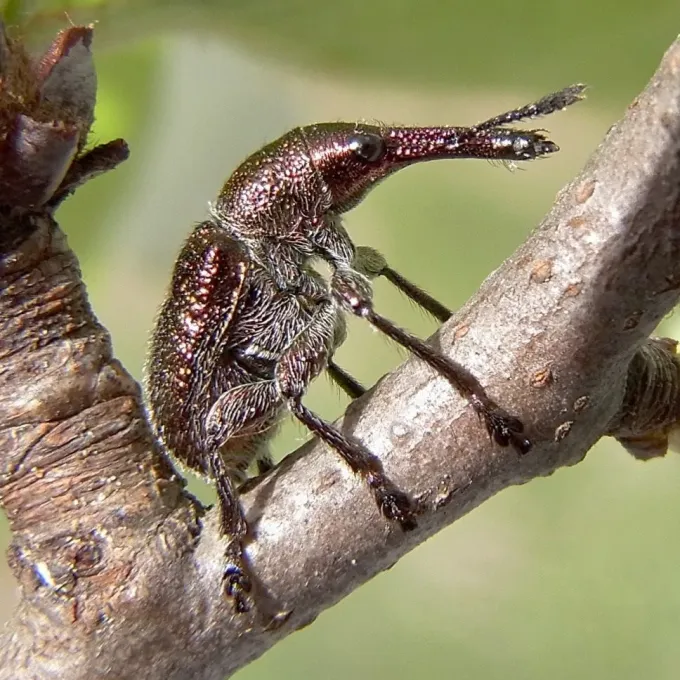
The cherry fruit weevil (Rhynchites auratus) is a beetle belonging to the Curculionidae family and the Coleoptera order. Adult beetles measure 5–9 mm and exhibit a brilliant metallic green or copper-gold appearance.
The insect is characterized by a long, slender rostrum (snout) which is used for both feeding on plant tissues and for preparing egg-laying sites on the fruits.
The larvae are legless, slightly curved grubs with a creamy-white body and a brown head capsule. They spend their entire developmental period inside the fruit pits.
Adults overwinter in the soil at depths of up to 15 cm. They emerge in the early spring, typically once temperatures rise sufficiently after the trees have bloomed.
When disturbed, the adult beetles exhibit a defensive behavior known as thanatosis, where they feign death and drop from the branches to the ground.
What it damages
The primary hosts of this pest include cherries and sweet cherries. However, they can also cause economic damage to plums, apricots, and other stone fruits.
Adult beetles damage trees by feeding on opening buds, blossoms, and young leaves, causing necrotic holes that hinder the tree's overall photosynthetic capacity.
The most severe damage is caused by the larvae, which bore into the developing pit of the fruit. This feeding destroys the kernel and results in fruit abortion.
The affected fruit typically turns yellow, stops growing, and drops prematurely from the tree, making it entirely unsuitable for commercial sale or consumption.
In years with high pest pressure, the cherry fruit weevil can compromise more than half of the total potential harvest if left unmanaged.
When it appears
Adult emergence from the soil coincides with the phenological stage of bud burst in stone fruit trees. This usually happens in the middle of spring.
The mating and oviposition period follows shortly after flowering. Females carefully deposit eggs into young, developing fruit while damaging the pedicel to prevent fruit growth.
Larval development inside the stone lasts approximately 4 to 6 weeks. Once finished, the mature larvae exit the fruit and move into the soil to pupate.
Pupation takes place in the soil throughout the summer. By late summer, the new generation of adults emerges, feeds slightly on foliage, and prepares for winter hibernation.
The entire lifecycle is strictly linked to the seasonal growth cycles of the host trees, making the pest presence predictable for targeted intervention.
Signs of infestation
The earliest signs of infestation are small, irregular punctures on leaves and flower petals, indicating that the adult beetles are actively feeding on the tree canopy.
- Premature fruit drop of small, green, and withered stone fruits.
- Visible bite marks or incisions on the fruit stems (pedicels) that cause the fruit to fail.
- Presence of metallic-colored beetles on the branches during the early morning hours.
Cutting open a prematurely fallen fruit and discovering a white larva inside the pit provides definitive proof of a cherry fruit weevil infestation.
Trees heavily attacked may show signs of thinning canopy and reduced growth vigor due to constant feeding damage by the adult population throughout the season.
Control measures
Sanitation is a critical control measure: gathering and destroying all fallen fruit (drops) is essential to remove larvae before they migrate into the soil for pupation.
Cultivating or tilling the soil around the base of the trees during the autumn or early spring helps disturb the overwintering adults and destroy pupal chambers.
Mechanical control, such as shaking the trees over sheets in the cool early morning, effectively collects the sluggish beetles and significantly reduces their numbers.
Application of appropriate insecticides during the post-flowering period can manage heavy infestations, provided that guidelines for safe application are followed.
Monitoring using sticky traps or tree banding can help track beetle activity and determine the precise timing for protective measures to prevent major crop losses.
Taxonomy
- Latin name
- Rhynchites versicolor
- Order
- Coleoptera (beetles)
- Family
- Attelabidae
- EPPO code
- RNCHVE
Discussion
No discussions yet — be the first.