
Apple fruit weevil
Rhynchites cribripennis
Description
How to identify
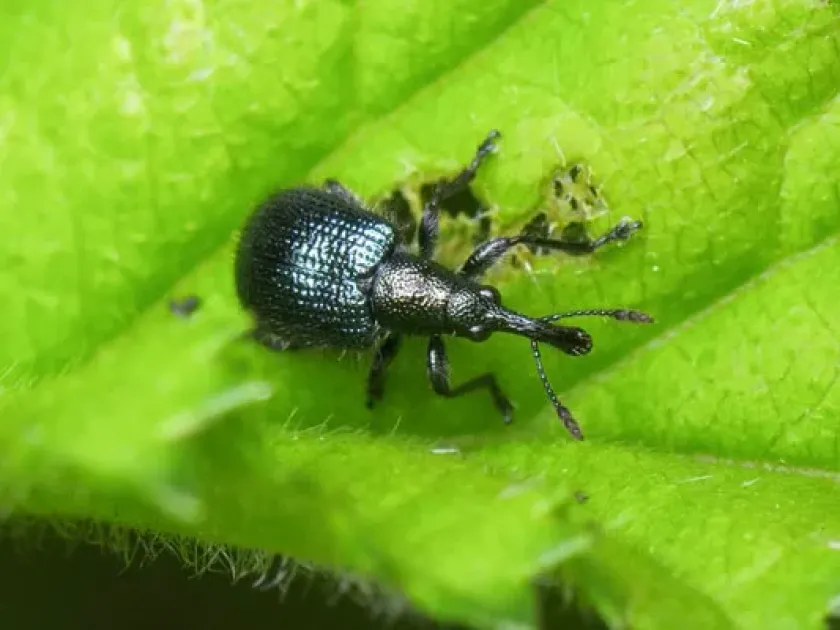
The apple fruit weevil (Rhynchites cribripennis) is a small beetle belonging to the Attelabidae family. Adults typically measure between 2.5 to 3 mm in length and are distinguished by a metallic green or bluish-green sheen.
Their bodies are covered in fine, short hairs, and their elytra exhibit distinct longitudinal grooves. The snout (rostrum) is relatively short and broad, a characteristic feature of this species compared to other weevils.
The life cycle involves complete metamorphosis. Overwintering occurs primarily in the soil as adults, usually at a depth of 10–15 cm, where they remain dormant until spring temperatures rise.
Larvae are legless, white-colored grubs with a brown head capsule. They develop exclusively within plant tissues, typically inside developing fruit or buds, which provides them with protection from environmental stress.
This pest is highly adaptable to various climatic conditions, making it a persistent issue in both commercial orchards and home gardens where sanitation measures are neglected.
What it damages
This weevil primarily infests pome fruits, including apples, pears, and quinces. Occasionally, it may also attack stone fruits like plums or apricots if populations are high.
Early season damage occurs when overwintered adults feed on swelling buds, causing them to dry out and fail to develop, which stunts the growth of the tree and reduces foliage density.
As the season progresses, adult weevils feed on flower buds and blossoms. This prevents normal pollination and fruit set, leading to direct yield loss before the fruit even begins to form.
The most significant damage is caused by larvae that develop inside the fruit. They hollow out the interior, causing the fruit to rot from within, turn brown, and drop prematurely from the tree.
Heavy infestations can result in the loss of up to 60-70% of the harvest if control measures are not implemented during the critical early growth phases of the trees.
When it appears
The activity of the apple fruit weevil begins in early spring, as soon as air temperatures consistently reach 10–12°C. This aligns with the bud-break phase of host trees.
Adults are most active during the blossoming period. They move through the canopy to feed on reproductive organs, completing their mating cycle during this time.
Egg-laying takes place once the fruitlets begin to develop. The female punctures the young fruit to deposit eggs, often damaging the fruit stalk to partially desiccate the tissue.
Larval development inside the fruit takes several weeks. By mid-summer, the mature larvae exit the fruit and burrow into the soil to pupate and eventually transform into the next generation of adults.
The new generation of adults usually emerges in late summer but remains relatively inactive, preparing to hibernate in the soil for the duration of the winter.
Signs of infestation
Visual identification of infestation starts with finding small, round feeding punctures on buds and young leaves in early spring, which often turn black and necrotic.
Blossoms that fail to open, dry up, and turn a brownish color are strong indicators of weevil activity. These damaged buds often remain attached to the tree for a short period.
Premature fruit drop in early summer is a definitive sign of larval infestation. Cutting open these fallen fruits usually reveals the white larvae or tunnels filled with excrement.
The fruit stalks of infested fruitlets often show small, clean incisions or rings made by the female when laying eggs, which restrict nutrient flow to the fruit.
- Small holes in developing buds.
- Premature abscission of young fruitlets.
- Brown, withered blossoms in the spring.
Control measures
Cultural control is highly effective; frequent cultivation of the soil under the tree canopy in mid-summer disrupts the pupal stage of the weevil, significantly reducing the next generation's population.
Sanitation is critical; daily collection and destruction of dropped fruit (fallen fruitlets) prevent the larvae from completing their life cycle and migrating into the soil.
Chemical protection should be applied using systemic insecticides during the "green cone" stage and immediately after petal fall to target adults before they lay eggs.
Manual shaking of trees onto plastic sheets early in the morning when beetles are lethargic is a viable strategy for small-scale orchards to reduce adult density.
Maintaining orchard hygiene by removing dead wood and maintaining vigorous tree growth helps minimize the attractiveness of the site to the apple fruit weevil.
Taxonomy
- Latin name
- Rhynchites cribripennis
- Order
- Coleoptera (beetles)
- Family
- Attelabidae
- EPPO code
- COENCR
Discussion
No discussions yet — be the first.