
Oak leaf-rolling weevil
Pterocolus ovatus
Description
How to identify
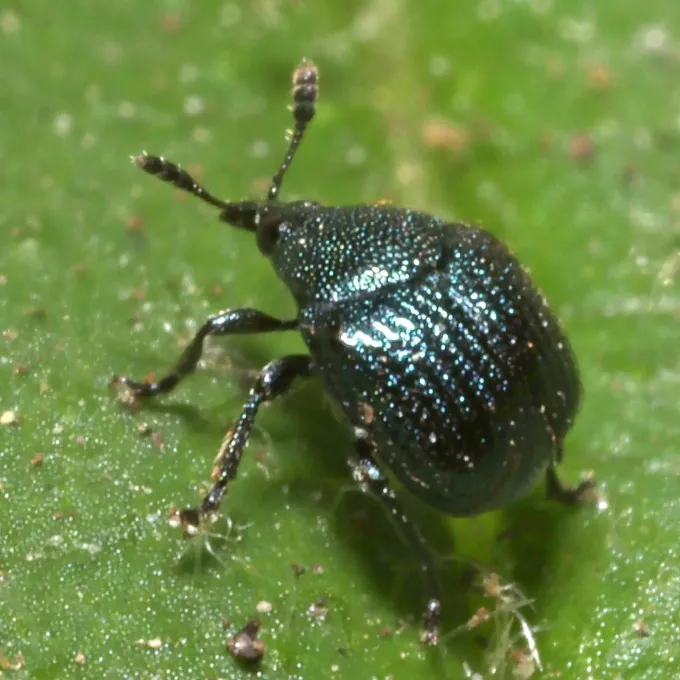
The oak leaf-rolling weevil, Pterocolus ovatus, belongs to the Attelabidae family. Adult beetles are characterized by a compact, pear-shaped body and a distinct metallic sheen, typically appearing blue, black, or violet.
The insect possesses a specialized rostrum (snout) used by the female to carefully cut and roll oak leaves into precise structures suitable for egg-laying.
Larvae are white or creamy, legless, and have a C-shaped body. They are almost exclusively found within the protective environment of the leaf rolls, which provide both shelter and food.
Identification is most accurately performed by examining the unique leaf-rolling technique, as different weevil species create specific patterns in their leaf nests.
These insects are highly specialized, confining their lifecycle to specific oak species, where they rely on host plant phenology for timing their development.
What it damages
The primary hosts of this pest are trees of the genus Quercus. The oak leaf-rolling weevil targets both young seedlings in nurseries and mature trees in forest stands.
Adult beetles feed on leaves, creating irregular holes, while the most significant damage occurs when females roll leaves for their larvae, effectively removing those leaves from the photosynthetic process.
Severe infestations can lead to premature leaf drop and overall tree stress, making the oaks more susceptible to secondary pests, drought, and fungal pathogens.
In nursery settings, the damage is particularly detrimental to the growth and form of young saplings, often causing growth distortions that reduce the timber value of the trees.
While mature trees rarely die from weevil activity alone, repeated annual infestations can significantly reduce forest growth rates and weaken the health of the entire stand.
When it appears
The lifecycle is tightly coupled with the spring budding of oak trees. Overwintered adults emerge from the soil just as the new leaves begin to unfurl.
Peak activity and mating occur during May, during which time females are highly industrious in constructing their leaf rolls for oviposition.
Larvae develop rapidly inside the leaf rolls over several weeks. Once development is complete, they vacate the leaf structure and drop to the soil to pupate.
Overwintering occurs in the soil or leaf litter, usually as pupae or adults, providing a survival mechanism against the harsh winter temperatures in temperate climates.
By mid-summer, the intensity of active leaf rolling decreases, leaving behind the characteristic brown, cylindrical leaf rolls hanging from or scattered beneath the canopy.
Signs of infestation
The most visible sign of an infestation is the presence of tightly rolled, cigar-shaped oak leaves hanging from the branches or found on the ground below.
Closer inspection of the affected leaves reveals precise, deliberate incisions along the margins, which are made by the female weevil to facilitate the folding process.
Affected leaves eventually turn brown and wither, creating a patchy or scorched appearance in the canopy, which can be distinguished from typical leaf diseases by the mechanical nature of the rolling.
Observing adult beetles on the foliage during spring is a direct indication of an active population, particularly on the undersides of leaves or along tender leaf petioles.
If the leaf rolls are opened, they usually contain eggs or larvae, confirming the current stage of the infestation within the nursery or forest stand.
Control measures
The most effective cultural control method in small orchards or nurseries is the manual collection and destruction of fallen leaf rolls to eliminate the larvae before they reach the soil.
Promoting natural biological control by maintaining habitats for parasitic wasps and birds, which are natural predators of the weevil, is essential for large-scale forest health.
In cases of severe economic impact, targeted applications of insecticides during the spring emergence phase can prevent widespread egg-laying and minimize damage.
Autumn soil cultivation under the canopy can disrupt the pupation sites of the weevil, significantly reducing the population that will emerge the following spring.
Regular monitoring of trees starting from early spring allows for early detection and the implementation of localized management strategies before the population reaches an outbreak level.
Taxonomy
- Latin name
- Pterocolus ovatus
- Order
- Coleoptera (beetles)
- Family
- Attelabidae
- EPPO code
- PTKLOV
Discussion
No discussions yet — be the first.