
Paroplapoderus weevil
Paroplapoderus
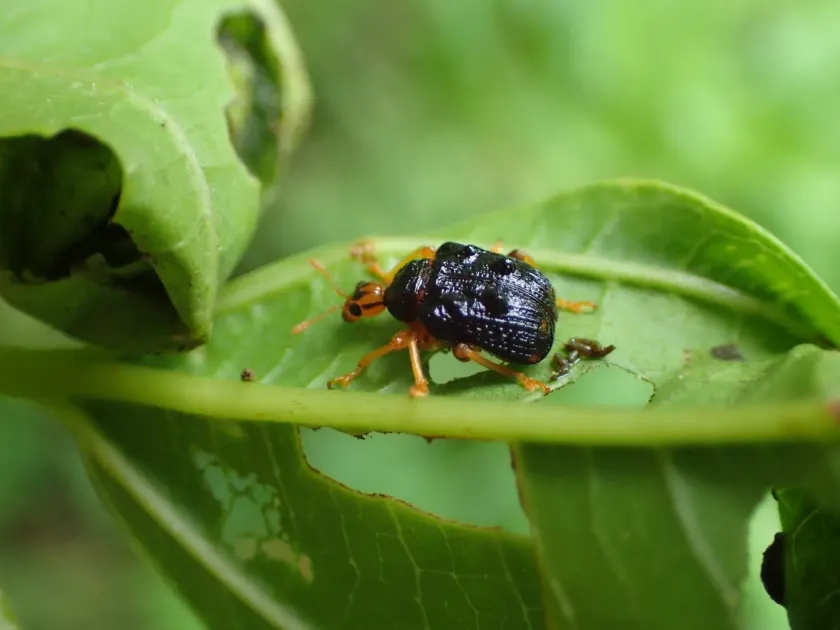
Description
How to identify
The Paroplapoderus weevil belongs to the family Attelabidae, within the order Coleoptera. These insects are easily identified by their elongated, tubular head structure, which is a hallmark of the leaf-rolling weevil family.
Adult insects are often small with iridescent or metallic colors, allowing them to blend in with foliage. They possess robust legs that are specially adapted for navigating leaf surfaces and performing complex folding tasks.
The larvae are legless, whitish grubs that develop internally within the protective rolls created by the female, living in a climate-controlled environment of their own making.
Morphologically, they are distinguished from other weevils by a more slender profile and a specialized snout used not just for feeding, but as a tool for architectural construction.
While they are natural inhabitants of woodland ecosystems, their population can explode in orchards or nurseries, leading to significant botanical damage.
What it damages
Paroplapoderus species primarily target broad-leaved trees and shrubs. Common hosts include apple and pear trees, as well as deciduous forest trees like birch, alder, and hazel.
Damage occurs primarily because the female cuts the leaf midribs and veins to induce wilting, making the leaf pliable enough to be rolled into a cigar-shaped nest for her eggs.
This process inhibits photosynthesis, causes early leaf abscission, and generally taxes the energy reserves of the plant, potentially leading to weakened growth in younger trees.
Furthermore, the rolled leaves act as breeding grounds for secondary pathogens, such as fungi or bacteria, which can cause leaf necrosis or twig dieback beyond the initial feeding damage.
Heavy infestations can result in significant loss of foliage during the active growing season, reducing the overall productivity and aesthetic value of ornamental or fruit-bearing plants.
When it appears
The activity of Paroplapoderus weevils typically begins in the spring as temperatures rise and young, succulent foliage becomes available for feeding and nesting.
The peak period for leaf-rolling activity occurs throughout late spring and early summer, coinciding with the reproductive phase when females are actively laying eggs inside leaf rolls.
The larval stage remains inside the leaf roll for several weeks, where they undergo development before pupating, often within the same protective structure or in the soil.
Activity may taper off mid-summer, although some regions may experience a second generation if climatic conditions remain favorable and host foliage is abundant.
Adult weevils overwinter in sheltered locations, typically in the leaf litter, topsoil, or within crevices of tree bark, emerging only when spring warmth signals the new season.
Signs of infestation
The most prominent sign of infestation is the presence of tightly rolled leaves, commonly referred to as leaf rolls or cigars, which may be attached to branches or found on the ground.
Close inspection of the foliage reveals precise, intentional incisions on the leaf petioles and main veins, which the female creates to force the leaf to soften and wither.
Small feeding punctures are visible on the leaf blades where adult weevils have been grazing, often creating a shot-hole appearance on affected plants.
Discoloration, such as yellowing or browning, often appears on leaves targeted for rolling, as the female disrupts the vascular flow of the leaf before securing it with silk or folds.
When disturbed, adult weevils are known to exhibit "thanatosis," or feigning death, and will drop from the canopy to the ground to avoid detection.
Control measures
The most effective cultural practice is the diligent collection and destruction of all rolled leaves, whether attached to the tree or fallen, to eliminate the next generation of larvae.
Autumn soil cultivation, including the tilling of the area beneath the tree canopy, helps destroy overwintering adults and prevents them from successfully emerging in the spring.
Chemical control involving systemic or contact insecticides should be applied when adult activity is first observed, but strictly before the eggs are securely encased in the leaf rolls.
Integrated pest management should also encourage the presence of predatory birds and beneficial insects, which act as natural regulators for weevil populations in the garden environment.
- Remove and destroy all leaf rolls
- Apply targeted insecticides in spring
- Till soil beneath canopy in autumn
- Monitor foliage regularly for early signs
Taxonomy
- Latin name
- Paroplapoderus
- Order
- Coleoptera (beetles)
- Family
- Attelabidae
- EPPO code
- PPLDSP
Discussion
No discussions yet — be the first.