
Gold weevil
Merhynchites
Description
How to identify
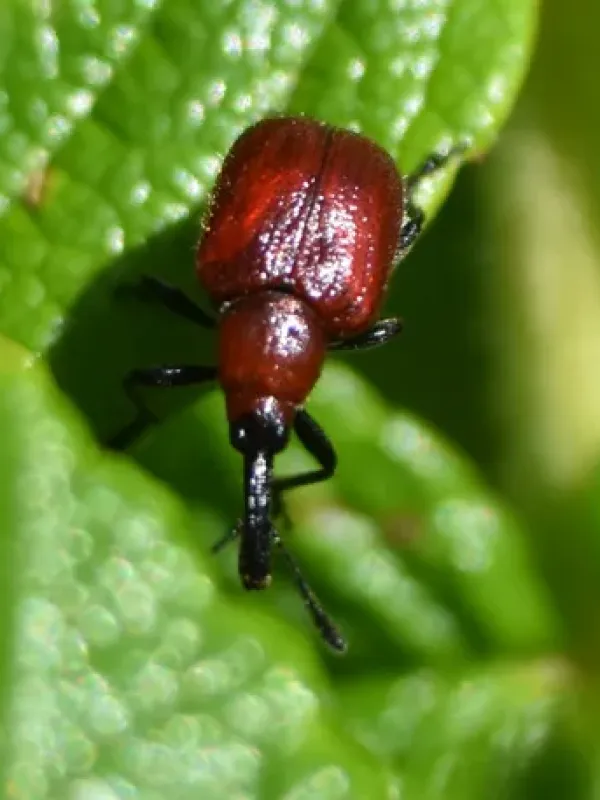
The Gold weevil (lat. Merhynchites auratus) is a small beetle belonging to the Attelabidae family. Adult specimens measure 2.5 to 3 mm in length and possess a distinctive metallic green or golden-blue exoskeleton.
The insect's head is elongated into a thin snout, which is a characteristic feature of the leaf-roller weevil family. The body is covered with sparse, light-colored hairs that give it a slightly dull, matte appearance.
The larva of this pest reaches 3–4 mm in length. It has a C-shaped, legless body, typically white with a light brown head. The larvae develop primarily inside fruits or young shoots of trees.
The pupa is white or yellowish and about 3 mm long. It develops within the soil, where the insect spends a significant part of its life cycle before emerging as an adult beetle.
Adults are highly active during sunny days and possess a natural defense mechanism: they quickly drop from branches to the ground when threatened, making manual inspection challenging.
What it damages
The Gold weevil primarily targets Rosaceae fruit trees. Apple, pear, plum, apricot, and cherry trees are the most susceptible to its feeding habits.
In early spring, adults feed on tree buds, boring deep holes into them. This activity causes the buds to dry out and fail to develop, directly impacting the potential yield for the entire season.
During the fruit setting stage, females lay eggs inside the fruits. The hatching larvae consume the pulp, causing fruits to drop prematurely and significantly reducing the quality of the harvest.
Beyond the fruits, the weevils attack leaf stalks and young shoots. By gnawing the stems, they cause leaves and tips to wilt, wither, and eventually fall off the tree.
In cases of heavy infestation, the Gold weevil can destroy a large portion of the crop and significantly weaken young trees, hindering their growth and preparation for the winter period.
When it appears
The life cycle of the Gold weevil is closely linked to the phenology of fruit trees. Adults emerge from the soil in early spring when the average daily temperature reaches 10–12°C.
Peak activity occurs during the bud burst and early flowering phases of apple trees, which is the most critical time for implementing protective measures.
Mating and egg-laying take place in late spring. A single female can deposit up to 100 eggs, placing them individually into cavities she chews into the fruit or ovaries.
Larval development inside the fruit takes about a month. After this period, the larva exits the dropped fruit and burrows into the soil to a depth of 10–15 cm to pupate.
Pupation occurs in the second half of summer, and the newly emerged beetles often remain in the soil through the winter, emerging only the following spring.
Signs of infestation
The first sign of an infestation is the widespread drying of buds, characterized by small, round holes left by the beetles while feeding.
In late spring, noticeable wilting of individual leaves or entire young shoots occurs, which remain dangling from partially chewed stems.
Young fruits may show signs of egg-laying, appearing as small dark dots or indentations that eventually develop into corky scabs or deformities.
Premature fruit drop in June is a key indicator of larval activity inside the fruit. Cutting open such fruits often reveals internal damage and the presence of the white, legless larvae.
Adult beetles can be detected by shaking branches over a sheet or cloth in the early morning when they are less mobile due to cooler temperatures.
Control measures
Cultural control methods include regular cultivation and hoeing of the soil beneath the trees, which disrupts the life cycle of pupating larvae in the ground.
Prompt collection and proper disposal of fallen fruit are essential to prevent larvae from entering the soil and completing their development.
In smaller orchards, physical removal by shaking the trees onto a collection sheet in the morning is an effective non-chemical control method.
Chemical control involves the use of systemic or contact insecticides. Applications are most effective during the bud burst stage and immediately after petal fall.
Always use approved pesticides and adhere strictly to dosage guidelines and pre-harvest intervals to ensure safety and effective management of the pest population.
Taxonomy
- Latin name
- Merhynchites
- Order
- Coleoptera (beetles)
- Family
- Attelabidae
- EPPO code
- MERHSP
Discussion
No discussions yet — be the first.