
Fruit weevil
Lasiorhynchites sericeus
Description
How to identify
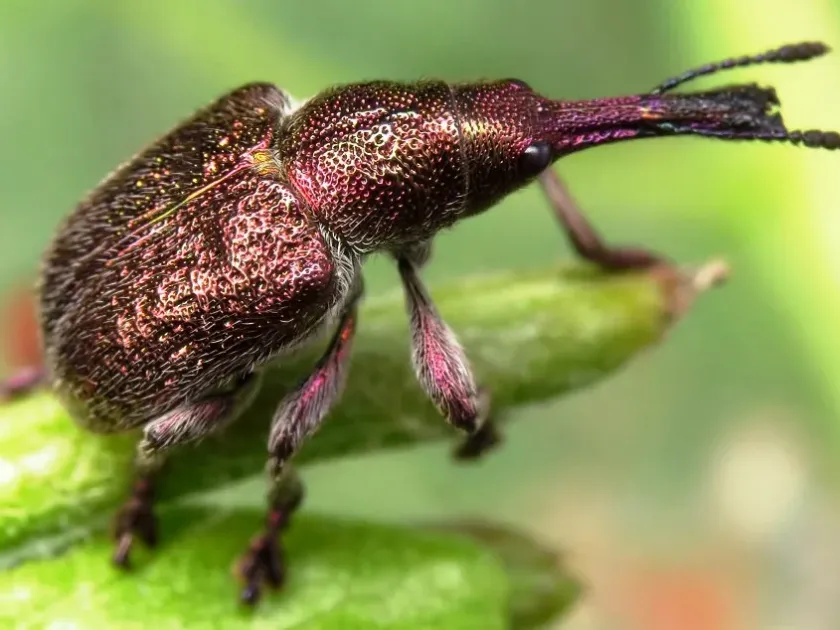
The fruit weevil (Lasiorhynchites sericeus) is a small beetle belonging to the order Coleoptera and the family Rhynchitidae. Adults are approximately 2.5 to 3 mm in length and are easily identified by their brilliant metallic blue or green sheen, often covered in sparse fine hairs.
The defining feature of this insect is its elongated rostrum (snout), which is used for both feeding on plant tissues and boring holes for oviposition. This snout gives the beetle its characteristic appearance typical of the weevil family.
The larval stage consists of legless, curved grubs that are whitish in color with a darker brown head. These larvae are specialized to develop inside the fruit and shoots of host plants, making them difficult to detect without careful inspection of the damaged tissue.
This species typically completes one generation per year. Adult weevils overwinter in the soil at depths of 10–15 cm, emerging in early spring when temperatures rise, coinciding with the budding of fruit trees.
Optimal environmental conditions for the fruit weevil include warm, dry spring weather, which promotes faster maturation and increased activity, often resulting in significant economic impact for fruit growers.
What it damages
The fruit weevil poses a substantial threat to a variety of pome and stone fruits, including apple, pear, plum, cherry, and apricot trees. Both adults and larvae contribute to the destruction of plant tissues.
Adults primarily feed on developing buds, young leaves, and blossoms. Their feeding behavior results in numerous small, ragged holes, which can compromise the tree's health and reduce the overall number of successful fruit sets.
The most severe damage occurs during the fruit formation stage. Females lay eggs inside the young fruit, and as the larvae hatch, they consume the internal pulp, leading to fruit decay and premature drop.
Infested fruits typically show deformation, dark spots, and stunted growth. These fruits are generally unsuitable for harvest, storage, or processing, leading to significant yield losses in commercial orchards and private gardens.
Additionally, the physical trauma caused by feeding and egg-laying makes trees more susceptible to secondary infections, such as fungi or bacteria. This weakens the tree canopy and may diminish its overall vigor over consecutive seasons.
Signs of infestation
The initial signs of a fruit weevil infestation are observed in early spring when small, round holes appear in opening buds and young leaves. In the early morning, adults can often be found perched on branches or near blossoms.
A key indicator of infestation is the premature drop of young fruitlets. Upon cutting these fallen fruits open, one may find small, creamy-white larvae, which confirms the presence of the pest within the orchard.
Drying or wilting of shoot tips is another tell-tale sign of female egg-laying activity. These damaged shoots often turn black and die, as the beetle's punctures disrupt the flow of nutrients to the tip of the branch.
During the flowering season, damaged blossoms may appear withered with jagged edges. A peculiar behavior of the adult weevil is its tendency to feign death and drop to the ground when disturbed, which can be observed during inspection.
Traces of frass (insect excrement) on the leaf surface and small, needle-like punctures on the skin of young fruits are secondary indicators that suggest a high population density, requiring immediate attention.
Control measures
Cultural control practices are essential for managing the fruit weevil. Autumn cultivation of the soil around the base of the trees helps disrupt the overwintering chambers, exposing larvae and adults to colder temperatures and predators.
Mechanical control, such as manual shaking of branches in the cool morning hours onto a sheet, is highly effective for reducing the number of adult beetles before they have the chance to lay eggs.
Chemical control involving systemic or contact insecticides should be applied during the budding and early flowering phases. Treatment timing is critical; it must occur before the beetles begin egg-laying inside the fruit tissue.
- Consistent collection and destruction of fallen fruitlets to eliminate larvae before they reach the soil.
- Pruning and destroying heavily infested, wilting shoots to reduce the pest population.
- The use of sticky bands on trunks to monitor activity and prevent adults from climbing the tree.
An integrated pest management (IPM) approach that rotates different classes of insecticides is recommended to prevent the development of pesticide resistance. Balancing these methods ensures effective control while protecting the orchard's productivity.
Taxonomy
- Latin name
- Lasiorhynchites sericeus
- Order
- Coleoptera (beetles)
- Family
- Attelabidae
- EPPO code
- LASRSE
Discussion
No discussions yet — be the first.