
Hairy leaf-rolling weevil
Involvulus pilosus
Description
How to identify
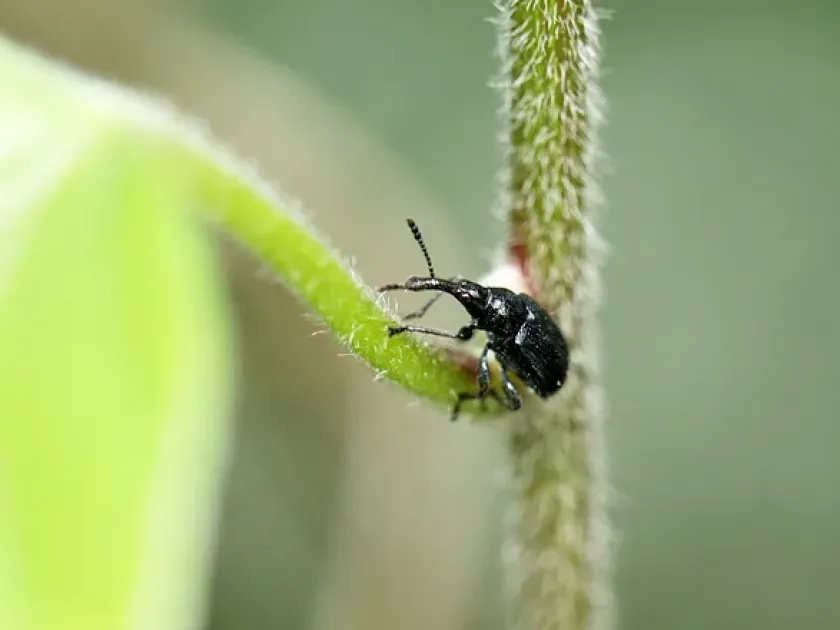
The Hairy leaf-rolling weevil (Involvulus pilosus) belongs to the Attelabidae family. This small beetle is distinguished by its elongated rostrum and the dense, hair-like pubescence covering its body.
Adult beetles typically exhibit dark shades, ranging from deep brown to bronze-black. Their small size and specific coloration help them blend in perfectly with the bark and foliage of host trees.
The larvae are legless and whitish with a dark head capsule, growing inside the tightly rolled leaves that the female prepares specifically for their development.
The lifecycle of this pest is closely synced with the phenology of fruit trees, with adults overwintering in the soil or under debris, emerging in early spring.
Females are known for their sophisticated leaf-rolling behavior, where they cut the leaf petiole to cause wilting, ensuring the leaf is suitable for egg deposition.
What it damages
This species primarily targets plants in the Rosaceae family, including apple, pear, plum, cherry, and other orchard staples.
The larvae and adults cause significant damage to foliage, which directly impacts the tree's photosynthetic capability and overall vigor.
Beyond leaves, the adults feed on flower buds and young fruit, leading to deformations, reduced yield, and premature fruit drop.
In high-infestation years, terminal shoot damage can occur, which stunts growth and affects the structural development of younger fruit trees.
Weakened trees are often more susceptible to secondary environmental stresses and various fungal infections entering through feeding wounds.
When it appears
The active phase begins in early spring, once temperatures consistently exceed 10-12 degrees Celsius, coinciding with bud burst.
Peak damage occurs during the budding and flowering stage, when females are most active in preparing leaf rolls for their offspring.
The larval stage develops inside the rolled leaves throughout the summer months before they drop to the ground to pupate.
A new generation of adults emerges in late summer, feeding moderately until the onset of cooler autumn weather signals the need for hibernation.
Overwintering occurs deep within the top layer of soil or under heavy leaf litter, where they remain until the next spring season.
Signs of infestation
The most prominent sign is the presence of neatly rolled, cigar-shaped leaves that turn brown and wilt while remaining attached to the branch.
Precisely executed cuts on leaf petioles are a definitive indicator of Hairy leaf-rolling weevil activity in an orchard.
Adult beetles can often be spotted on the foliage, although they tend to exhibit "thanatosis," or feigning death, by dropping to the ground when disturbed.
Damage to young fruit, appearing as small, circular entry or feeding holes, often confirms the presence of the pest population.
Widespread premature fruit drop combined with the observation of leaf rolls is a clear signal that the pest population has reached a critical threshold.
Control measures
Sanitation is key; collecting and disposing of all rolled leaves and fallen fruit is essential to remove larvae before they enter the soil.
Cultivating the soil in the root zone (tilling) during the late summer and autumn disrupts pupation and kills overwintering adults.
Manual control, such as shaking the trees over a collection sheet during cool morning hours, can significantly reduce adult numbers in small gardens.
Chemical control should be implemented strategically, focusing on pre-flowering and post-flowering windows to minimize impact on pollinators.
- Application of approved contact insecticides.
- Use of systemic agents for prolonged protection.
- Integration of biological controls like entomopathogenic fungi.
Taxonomy
- Latin name
- Involvulus pilosus
- Order
- Coleoptera (beetles)
- Family
- Attelabidae
- EPPO code
- INVOPI
Discussion
No discussions yet — be the first.