
Copper leaf-rolling weevil
Haplorhynchites aeneus
Description
How to identify
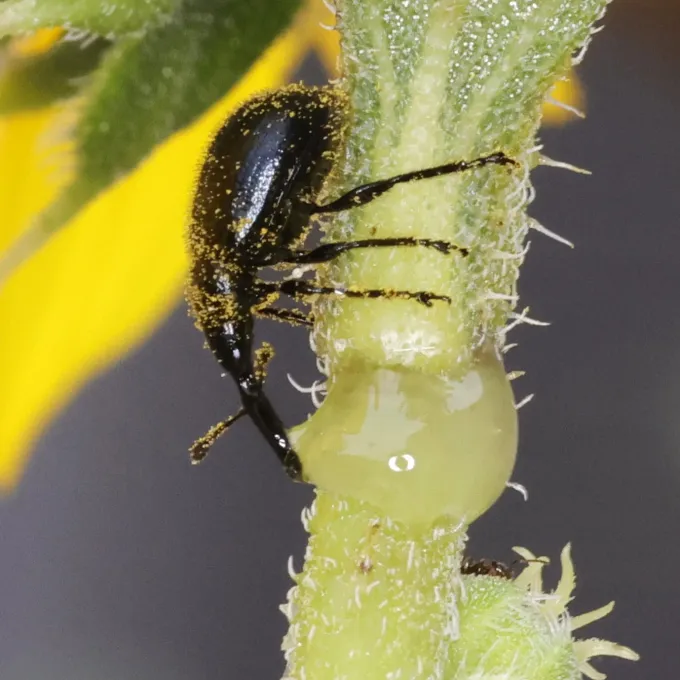
The Copper leaf-rolling weevil (Latin: Haplorhynchites aeneus) is a beetle species belonging to the family Attelabidae within the order Coleoptera. It is recognized by its brilliant bronze-copper metallic sheen.
Adult beetles are relatively small, typically measuring between 4 to 6 millimeters in length. They possess a prominent snout, which is a characteristic morphological feature of the weevil family.
The larvae are legless, C-shaped, and creamy-white in color, often found burrowing inside the tissues of host plants where they complete their development.
The species exhibits a robust biological adaptation to diverse climates, usually overwintering as adults in the upper soil layers or beneath leaf litter near host trees.
Their emergence occurs early in the spring, synchronized with the budding phase of fruit trees, which allows them to feed on nutrient-rich developing plant parts.
What it damages
This weevil primarily infests members of the Rosaceae family, with apples, pears, plums, and cherries being the most susceptible crops to its attack.
Adult beetles inflict damage by feeding on buds, young foliage, and developing fruitlets, causing punctures that lead to tissue necrosis and premature fruit drop.
Larval activity is particularly destructive, as the larvae tunnel into the fruit flesh, causing decay and rendering the produce unmarketable and prone to rotting.
Significant infestations can lead to substantial yield losses, sometimes destroying the majority of the potential crop on an individual tree during peak years.
Persistent feeding on shoots and buds weakens the overall health of the tree, potentially reducing its vigor and increasing susceptibility to secondary environmental stressors.
When it appears
The life cycle begins in early spring when temperatures rise above 10-12°C, prompting adult weevils to emerge from their overwintering sites.
Mating and oviposition occur throughout the spring flowering period, as the female selects suitable sites—often developing fruits or tender shoots—to deposit eggs.
Larvae develop throughout the summer months, feeding continuously inside the host tissue until they are ready to pupate.
Pupation typically takes place within the soil, where the larvae migrate after exiting the fallen fruit to complete their transformation into adulthood.
By late summer, the new generation of adults emerges, feeds minimally on foliage, and then seeks shelter in the soil to undergo winter dormancy.
Signs of infestation
Visible signs of infestation include small, deep holes in the skin of young fruits and shriveled, necrotic areas on flower buds.
Premature fruit drop is a strong indicator of larval presence, as the fruit sheds due to the internal damage caused by the developing weevil larvae.
Foliage damage appears as irregular or ragged leaf edges where adult beetles have fed, which can be observed during regular orchard inspections.
Careful examination of fallen fruit often reveals tiny exit holes or internal tunneling accompanied by larval excrement inside the flesh.
- deformed or blackened flower buds;
- presence of metallic-bronze beetles on leaves;
- wilting of young shoots;
- premature shedding of unripe fruit.
Control measures
Effective management includes mechanical soil cultivation in the root zones during autumn and spring to disturb and kill pupating larvae in the soil.
Sanitation is paramount: regular collection and disposal of fallen fruit help to break the life cycle by preventing larvae from reaching the soil to pupate.
Manual collection of beetles by shaking branches over cloths during early morning hours—when the insects are sluggish due to lower temperatures—is highly recommended.
Chemical control involving contact-stomach insecticides may be necessary during severe outbreaks, provided they are applied in accordance with regional regulations.
Encouraging natural predators such as insectivorous birds and parasitic wasps can help maintain the weevil population below the economic injury level.
Taxonomy
- Latin name
- Haplorhynchites aeneus
- Order
- Coleoptera (beetles)
- Family
- Attelabidae
- EPPO code
- HAPRAE
Discussion
No discussions yet — be the first.