
Pear weevil
Haplorhynchites
Description
How to identify
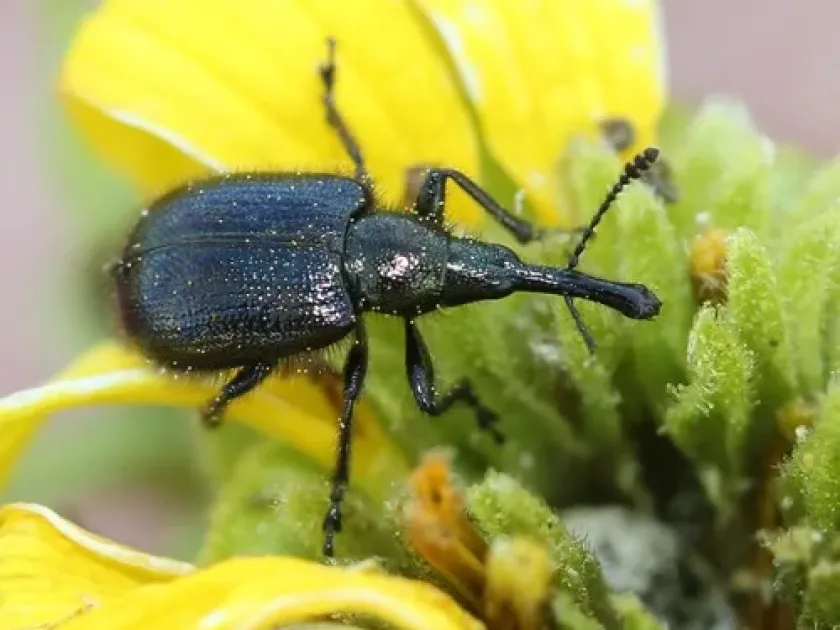
The pear weevil (scientific name: Haplorhynchites coeruleus) is a member of the Coleoptera order and the Rhynchitidae family. These insects are small, typically measuring 3–4 mm in length, and are easily recognized by their metallic blue or greenish coloration.
Adult weevils possess a characteristic long snout, which is typical for this family. This organ is used not only for feeding but also for drilling into plant tissues for oviposition.
The larvae are white, legless, and curved, with a distinct dark head capsule. They spend their entire development phase hidden inside the plant, which makes early detection quite difficult for orchardists.
Pupation occurs within the soil, where the insect undergoes its final transformation before emerging as an adult in the following season, completing the cycle.
These pests overwinter primarily as adults in the topsoil layer or beneath garden debris, allowing them to emerge rapidly in early spring when the weather warms up.
What it damages
The pear weevil infests various pome fruits, including pears, apples, quinces, and hawthorns. Both adults and larvae contribute to significant crop losses in commercial and home orchards.
In spring, adults damage buds and young leaves by creating small punctures. This feeding behavior disrupts the early development of foliage and reduces the tree's overall photosynthetic capacity.
The most severe damage occurs during the flowering and fruit set phase. Adults feed on peduncles, causing the stems to wither and the developing fruit or shoots to blacken and eventually die.
Females lay eggs inside the shoots and then bite them, causing the characteristic wilting and drooping of affected branches, which is a hallmark of this specific pest's activity.
Larval development inside these withered shoots destroys the vascular system of the growth, leading to stunted branches and significantly reduced yields for the season.
When it appears
The adult pear weevil emerges in early spring, synchronized with the onset of bud swelling and leaf opening. Peak activity typically coincides with the flowering stage of pome trees.
The egg-laying period spans from late spring through early summer, when the new shoots are soft enough for the female to perform her drilling and oviposition activities.
Larvae develop throughout the summer months within the fallen or wilting plant parts. As they mature, they eventually exit the plant material to enter the soil for pupation.
A second generation may emerge or activity may cease depending on the geographical region and local climate, with Southern areas often showing more rapid development cycles.
By autumn, as temperatures drop, the insects move into the soil or under surface debris to find suitable overwintering sites, remaining dormant until the next spring season.
Signs of infestation
The first sign of an infestation is the presence of multiple tiny holes or "windows" on the young leaves appearing shortly after the tree starts its spring growth.
A very prominent symptom is the mass wilting and blackening of shoot tips. These shoots hang downwards, appearing broken, yet they often remain attached to the tree by a thin layer of bark.
Close examination of the damaged shoots reveals precise drill marks made by the female, often accompanied by small amounts of frass or debris near the entry holes.
Finding wilted, blackened shoots on the orchard floor is a critical warning sign that larvae have been active and are potentially entering the soil stage of their cycle.
In nurseries or young plantations, stunted growth and deformed branch structures are reliable long-term indicators of a recurring pear weevil problem in the area.
Control measures
Sanitation is a primary control method: regularly collecting and burning fallen, infested shoots prevents the larvae from reaching the soil and completing their transformation.
Deep cultivation or tilling of the soil under the tree canopy in autumn can expose pupae to freezing temperatures and natural predators, significantly reducing the next season's population.
Chemical control involving systemic or contact insecticides should be applied during the pre-blossom and post-blossom periods, strictly following local safety guidelines and spray schedules.
In home orchards, a simple mechanical method involves spreading a light-colored cloth under the canopy and shaking the branches in the morning, when beetles are sluggish.
Installing pheromone traps and sticky bands can help monitor weevil activity, providing the necessary data to decide if and when to implement chemical intervention for better protection.
Taxonomy
- Latin name
- Haplorhynchites
- Order
- Coleoptera (beetles)
- Family
- Attelabidae
- EPPO code
- HAPRSP
Discussion
No discussions yet — be the first.