
Euops weevil
Euops
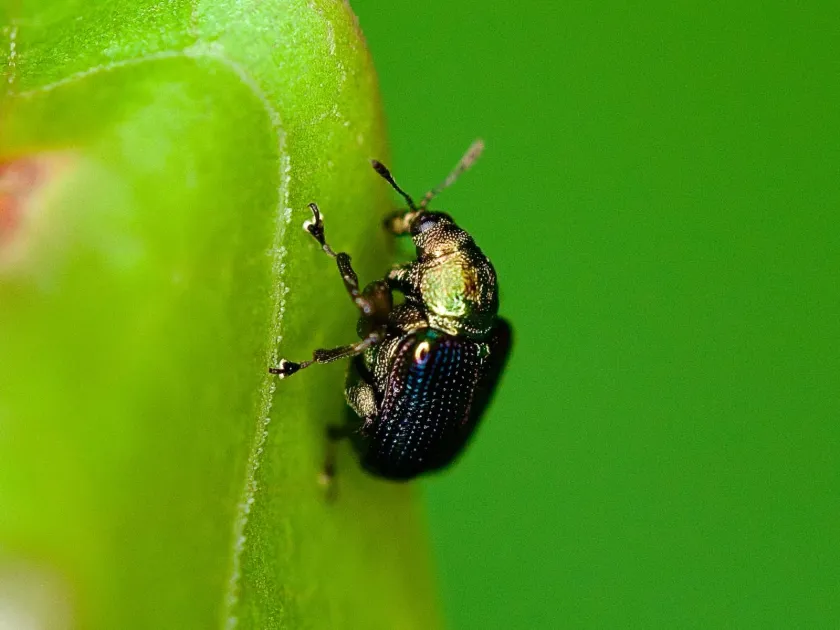
Description
How to identify
The genus Euops belongs to the family Attelabidae, commonly known as leaf-rolling weevils, due to their unique habit of rolling leaves.
Adult weevils are small, often exhibiting metallic or bright coloration, and feature the characteristic elongated snout of the Curculionoidea superfamily.
These insects are highly specialized in their behavior, with females displaying intricate skills to manipulate plant tissue for reproduction.
The larvae are typically legless, white to cream-colored grubs that grow inside the protective environment of a rolled leaf.
They are generally found in forests and orchards, where they utilize specific host plants for both feeding and nesting purposes.
What it damages
Euops weevils feed on various deciduous trees and shrubs, causing damage to both the foliage and the overall structure of the plant.
The primary harm is caused by the female's cutting of leaf veins, which allows the leaf to wilt and be rolled into a protective cradle.
Larval feeding destroys the internal leaf tissue (parenchyma), which disrupts photosynthesis and leads to premature leaf senescence.
Young trees in nurseries are particularly vulnerable, as repeated defoliation or leaf curling can stunt vertical and lateral growth.
While often considered a minor pest, high populations in specific seasons can lead to significant aesthetic damage and loss of plant vigor.
When it appears
The life cycle is closely synchronized with the spring phenology of host plants, beginning as soon as fresh, tender leaves emerge.
Adults emerge from hibernation sites, such as leaf litter or topsoil, to feed and mate during the warm spring months.
Oviposition occurs throughout late spring and early summer, when the leaves have enough moisture to be rolled without breaking completely.
The larval stage is relatively short, usually lasting several weeks, as the larvae consume the interior of their leaf-roll structure.
Depending on the species and geographical climate, one or more generations may occur, with adults often entering diapause by late summer.
Signs of infestation
The most distinctive sign of a Euops infestation is the presence of neatly rolled or folded leaves hanging from the branches.
Close inspection of the stem or petiole of the rolled leaf will reveal specific incisions made by the female weevil to induce wilting.
Adult feeding on non-rolled leaves appears as small, irregular holes or grazing marks on the surface of the leaf blade.
If a rolled leaf is opened, the presence of frass (larval excrement) or the larvae themselves confirms the active infestation.
Widespread curling and necrotic leaf tips across the crown of a tree are clear indicators that a significant population is present.
Control measures
The most effective manual control method is to remove and destroy the rolled leaves before the larvae emerge to pupate.
Sanitation practices such as raking and disposing of fallen leaf litter in autumn significantly reduce the overwintering population.
Chemical control with systemic or contact insecticides can be used in spring when adults are most active and visible on the foliage.
Encouraging biodiversity in the garden helps maintain populations of parasitoid wasps that naturally control the weevil larvae.
Regular monitoring of host plants in early spring allows for timely intervention before the pests can complete their reproductive cycle.
Taxonomy
- Latin name
- Euops
- Order
- Coleoptera (beetles)
- Family
- Attelabidae
- EPPO code
- EUOPSP
Discussion
No discussions yet — be the first.