
Hazel leaf roller
Deporaus marginatus
Description
How to identify
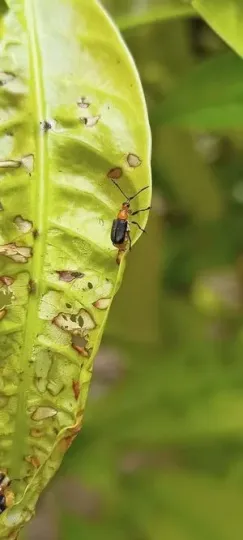
The hazel leaf roller (Deporaus marginatus) belongs to the Attelabidae family within the order Coleoptera. It is a small weevil, typically measuring 4 to 6 mm in length. Its body is sparsely covered with hairs, ranging in color from brown to dark blackish-brown.
A distinctive feature of this species is its elongated rostrum (snout), adapted for cutting and manipulating leaf tissues. There are slight morphological differences between males and females related to the feeding and egg-laying apparatus.
The larvae are legless, curved, and creamy-white in color. They spend their entire developmental period inside rolled leaves, where they are protected from environmental factors and predators.
Pupation usually occurs in the soil or beneath leaf litter. This stage serves as a dormant phase, allowing the insect to survive unfavorable periods before emerging as an adult in the spring.
Adult beetles are elusive and often hide within the tree canopy, making them difficult to spot during routine inspections unless the branches are shaken over a catching sheet.
What it damages
The primary hosts of this pest include various nut-bearing trees, particularly hazelnuts (filberts) and walnuts. It can also occasionally infest other deciduous trees growing in close proximity to orchards.
Both adult beetles and larvae cause damage to the foliage. Adults feed on the leaf tissue, while larvae consume the inner parts of the leaf rolls, significantly reducing the tree's photosynthetic efficiency.
The most severe damage occurs during the egg-laying process, as the female cuts the leaf blades in a specific pattern to roll them into tight cigars. This practice destroys significant amounts of healthy leaf surface.
Heavy infestations can lead to premature leaf drop, which weakens the tree's overall vigor. This significantly impacts the development of fruit buds and the overall yield of the nut orchard.
Weakened trees become more susceptible to secondary stressors, including fungal infections, drought, and extreme winter temperatures, potentially leading to branch dieback.
When it appears
The life cycle of the hazel leaf roller is closely synchronized with the phenology of its host plants. Adults typically emerge from hibernation in the spring, coinciding with the flushing of new leaves.
Peak activity occurs during June and July, when mating and egg-laying take place. During this window, gardeners may observe intense leaf-rolling activity throughout the canopy.
Larval development takes several weeks inside the protective leaf rolls. Once fully mature, the larvae leave the rolls and burrow into the soil to pupate, where they remain until the next season.
The species completes one generation per year. This predictable life cycle allows for effective management if monitoring is conducted at the correct time in the early summer.
Overwintering occurs in the soil as pupae or adults, providing a stable environment that ensures the survival of the population even during harsh winter conditions.
Signs of infestation
The most obvious sign of an infestation is the presence of neatly rolled leaves that look like cigars, hanging from the branches or scattered on the ground beneath the tree.
Carefully unrolling these structures will reveal creamy-white larvae and frass (waste) inside. The leaf tissue within the roll often shows signs of heavy feeding and necrosis.
Affected foliage quickly turns brown, withers, and dies. A heavily infested canopy may appear stunted or scorched, resembling damage caused by heat or chemical burn.
Early in the season, one can observe subtle cuts on the leaves before they are completely rolled. Spotting these early signs is crucial for preventing widespread damage.
Widespread leaf drop during the peak summer months is a major indicator of high pest pressure and suggests that control measures are urgently required.
Control measures
The most effective cultural control method is the regular collection and disposal of rolled leaves. By removing these, you eliminate the larvae before they drop into the soil to pupate.
Insecticide application is best timed for the period when adult beetles are active on the foliage but before they have finished rolling the leaves, as the rolls provide excellent protection.
- Sanitary pruning of infested branches.
- Cultivating the soil under the tree canopy in late autumn to expose and destroy pupae.
- Using entomopathogenic fungi or bacteria to target larvae in the soil or on leaves.
Maintaining strong tree vigor through proper irrigation and nutrition helps the trees withstand pest attacks and recover more quickly from foliage loss.
Using pheromone traps can help monitor the arrival of adult beetles, allowing for precise timing of management interventions and reducing the need for broad-spectrum chemicals.
Taxonomy
- Latin name
- Deporaus marginatus
- Order
- Coleoptera (beetles)
- Family
- Attelabidae
- EPPO code
- DEPOMA
Discussion
No discussions yet — be the first.