
Birch leaf roll weevil
Deporaus betulae
Description
How to identify
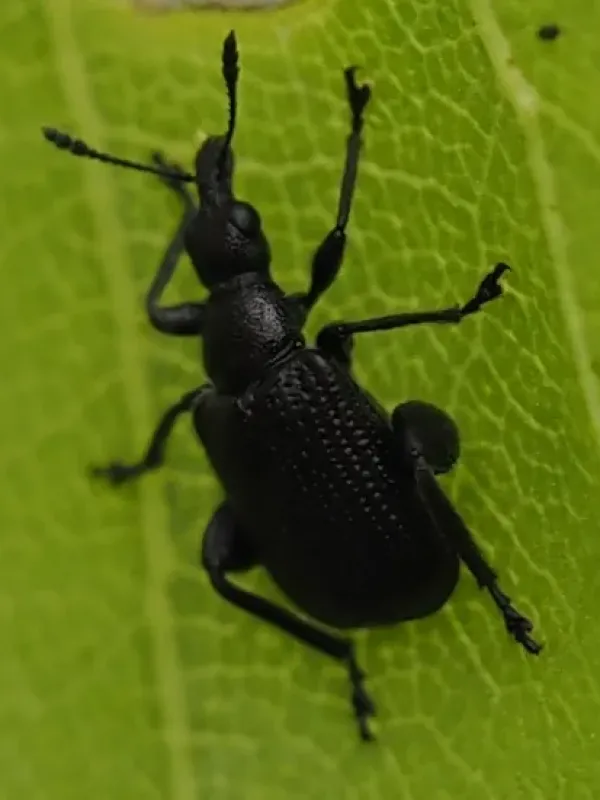
The birch leaf roll weevil (Deporaus betulae) is a member of the Attelabidae family within the order Coleoptera. Adult beetles are small, typically ranging from 3 to 5 mm in length, and possess a distinct shiny black appearance.
The body is relatively smooth, sometimes featuring fine, pale hairs. A key diagnostic feature is the elongated snout (rostrum), which is characteristic of the Attelabidae family.
Larvae are legless, slightly curved, and creamy-white with brown head capsules. They develop exclusively within the leaf rolls created by the females.
These beetles are highly active on sunny days and exhibit a defense mechanism known as thanatosis, where they drop from branches and play dead when disturbed.
The life cycle involves complete metamorphosis, consisting of egg, larva, pupa, and adult stages. Overwintering occurs primarily as adults in the soil or leaf litter.
What it damages
The primary host plant is the birch tree (Betula), though the weevil is also known to infest alder, hazel, and occasionally some fruit-bearing trees.
Adult beetles feed on young leaves, creating small, irregular holes. While this feeding does not usually kill the tree, it reduces the photosynthetic capacity of the foliage.
The most significant damage occurs when females cut and roll leaf blades into conical shapes, essentially creating a nursery for their larvae.
In cases of high population density, entire sections of a tree canopy may become covered in these leaf rolls, leading to aesthetic degradation and premature leaf drop.
Consistent annual infestation can stress young saplings, potentially stunting their growth and making them more susceptible to other environmental stressors.
When it appears
Adults emerge from their overwintering sites in the soil during spring, usually in May, once consistent warm weather arrives.
The primary period of mating and leaf-rolling activity lasts through late June, coinciding with the rapid growth phase of birch foliage.
Larvae develop inside the rolled leaves for several weeks, feeding on the decaying tissue provided by the female's specialized cutting technique.
Upon maturity, larvae vacate the leaf rolls and descend into the soil to pupate during mid-to-late summer.
The new generation of adults typically emerges before late autumn, feeding briefly before finding suitable sites to overwinter in the ground.
Signs of infestation
The most visible indicator of this pest is the presence of tightly rolled, cone-shaped leaves scattered throughout the canopy.
Careful observation during hot, sunny afternoons may reveal the black adult beetles resting on leaves or along the branches.
Foliage damage is characterized by multiple small, circular perforations scattered across the leaf blade where adults have fed.
The presence of numerous fallen leaf rolls on the ground beneath the host tree is a definitive sign of high weevil activity.
If a leaf roll is carefully unraveled, a small, white larva or its frass (waste) can usually be found inside, confirming an active infestation.
Control measures
The most effective non-chemical control method is the manual collection and destruction of fallen leaf rolls to interrupt the larval development cycle.
Cultivating or turning over the soil beneath host trees in the autumn helps expose and destroy pupae, significantly reducing the next year's population.
For ornamental trees or severe infestations, targeted insecticide applications during the adult emergence phase in late spring can be highly effective.
- Apply insecticides containing pyrethroids or acetamiprid when beetles are first sighted.
- Maintain tree health through proper fertilization and watering to improve natural resilience.
- Encourage insectivorous bird populations, which naturally predate on adult weevils.
Regular monitoring of young birch trees during late spring allows for early intervention, preventing the need for broad-spectrum chemical treatments.
Taxonomy
- Latin name
- Deporaus betulae
- Order
- Coleoptera (beetles)
- Family
- Attelabidae
- EPPO code
- DEPOBE
Discussion
No discussions yet — be the first.