
Leaf roller weevil
Deporaus
Description
How to identify
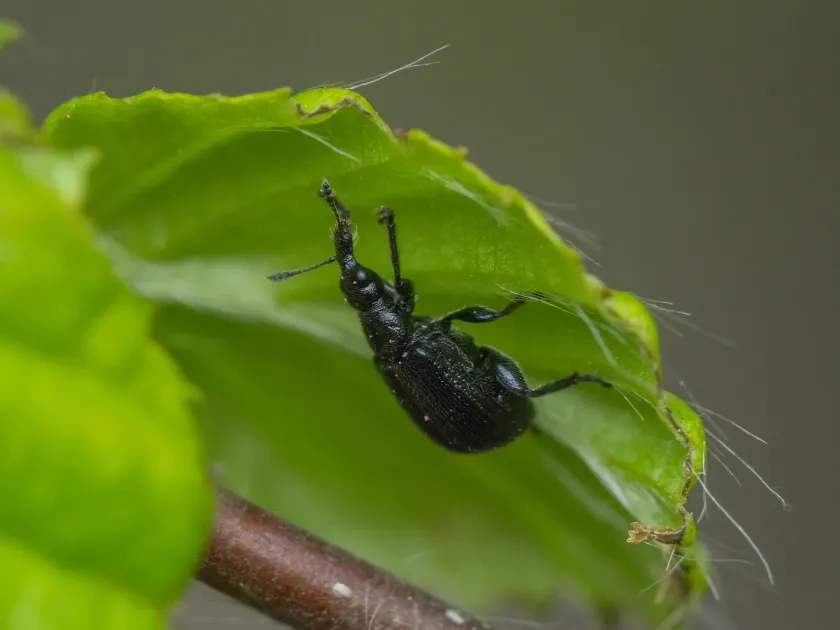
Beetles of the genus Deporaus belong to the family Attelabidae, commonly known as leaf roller weevils. These are small insects, 3 to 7 mm long, characterized by an elongated pronotum and often a metallic luster on their elytra.
The head of the beetle is extended into a rostrum, which females use to prepare the leaf blade before laying eggs. The coloration of adults varies from black and blue to bronze.
Leaf roller weevil larvae are legless, whitish or cream-colored, with a dark head and a curved C-shaped body. They develop exclusively inside rolled leaves, which serve as their food source.
The appearance of the insect may differ slightly depending on the specific species, but the general morphology remains consistent across the entire family.
Identifying the pest is most effective during the leaf-rolling period, as it is quite difficult to spot the small beetle visually on the tree canopy.
What it damages
Leaf roller weevils cause significant damage to fruit, ornamental, and forest crops. Host plants include grapes, birch, apple, pear, plum, cherry, and hazelnut.
Damage is caused by both adults, which chew holes in leaves and young shoots, and larvae, which feed on the tissues of the rolled leaf “cigars”.
Mass infestation leads to premature leaf fall, weakened plant immunity, and reduced photosynthesis intensity, which directly affects tree productivity.
In cases of severe infestation, deformation and drying of young shoots can be observed, which is critical for nursery saplings and young trees.
Economic losses result from the loss of produce quality and reduced winter hardiness of perennial plantations due to disturbed vegetation processes.
When it appears
The emergence of beetles from overwintering sites, where they spend the cold period in the soil or under leaf litter, usually coincides with the bud break phase and the start of active leaf growth in the spring.
Adult activity peaks in May and June when mating and egg-laying in specially rolled leaves occur.
Larval development inside the leaf rolls lasts several weeks, after which they enter the soil for pupation. Depending on the climatic zone, a second generation may develop in mid-summer.
In autumn, adults and pupae enter hibernation, completing the annual life cycle of the pest in the garden.
Weather conditions, such as a wet spring, can contribute to a more massive emergence of the pest early in the season.
Signs of infestation
The main and most recognizable sign of the leaf roller weevil's presence is the occurrence of leaves rolled into tight tubes or funnels on the branches.
Leaves inside these “cigars” gradually turn brown, dry out, and eventually fall to the ground, creating favorable conditions for larval pupation.
Upon careful inspection, one can find characteristic perforated damage on undamaged leaves, caused by beetles during additional feeding periods.
In the early stages, damage may only be visible as slight curling of leaf margins, but as the female continues her work, the tube becomes clearly visible.
- Presence of rolled leaves on the tree.
- Browning and drying of leaf fragments.
- Premature drop of buds or leaves.
Control measures
Agronomic methods are the basis of control: it is important to collect and destroy fallen “cigars” containing larvae before the pest enters the soil.
Regular cultivation of tree trunks in autumn and early spring helps destroy the pest's overwintering sites and reduce the total population in the area.
During the period of mass emergence, treating trees with systemic or contact insecticides approved for garden use is effective.
The use of biological preparations (based on bacteria or fungi) shows good results with moderate pest infestation while preserving beneficial entomofauna.
It is important to monitor the condition of young saplings, as leaf damage by the leaf roller weevil is particularly dangerous for them and can lead to plant death.
Taxonomy
- Latin name
- Deporaus
- Order
- Coleoptera (beetles)
- Family
- Attelabidae
- EPPO code
- DEPOSP
Discussion
No discussions yet — be the first.