
Grape leaf roller
Byctiscus venustus
Description
How to identify
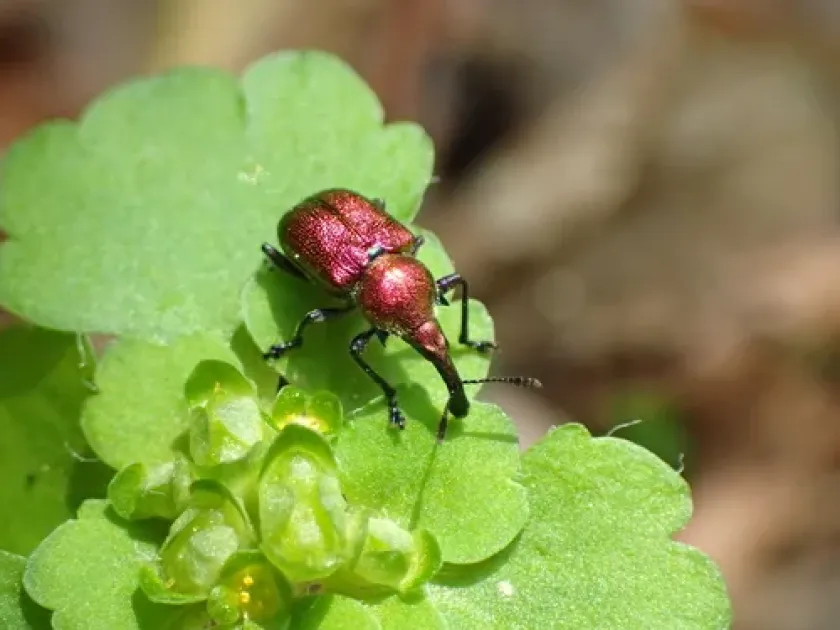
The Grape leaf roller (Byctiscus venustus) belongs to the family Attelabidae, order Coleoptera. Adult beetles are 6–9 mm long with a distinct metallic blue, green, or gold coloration.
The beetle is characterized by a prominent snout (rostrum), which is especially developed in females to perform precise cuts on leaves during the construction of their characteristic leaf rolls.
The larvae are legless, C-shaped, and creamy-white with a brown head, living entirely within the protected environment of the rolled leaves, which protects them from predators and pesticides.
These insects exhibit a cryptic lifestyle. During the day, they are often found on the upper foliage, but they react to vibrations by dropping to the ground and playing dead.
The life cycle can vary based on local climatic conditions, often taking one full year to complete, with adults hibernating in the soil or leaf litter.
What it damages
The primary host for this pest is the grapevine. However, when populations are high, they may also attack various trees, including birch, lime, alder, and sometimes stone fruits.
Feeding occurs on leaves, shoots, and inflorescences. The adult beetles chew holes in the foliage, while the larvae feed on the inner tissues of the rolled leaves.
The damage to the foliage disrupts photosynthesis, which is critical for vine health, sugar accumulation in berries, and the overall ripening process of the grapevine wood.
In young plantations, significant leaf loss caused by the roller can retard the development of the vine, making the plants more susceptible to winter frost damage.
In addition to direct structural damage, the punctures and cuts made by the female provide entry points for secondary fungal pathogens, further weakening the vine.
When it appears
Adults emerge from their hibernation sites in the soil during late spring, coinciding with the bud-break and early leaf development stages of the grapevines.
The peak activity for mating and egg-laying occurs between May and June. During this time, females are highly active in creating their leaf rolls for their offspring.
Larval development happens throughout early summer inside the leaf rolls. Once fully grown, the larvae drop to the ground to pupate in the soil.
A second generation of adults may appear in mid-to-late summer, feeding on the remaining foliage before seeking out protected overwintering sites as temperatures drop.
Weather patterns, particularly warm and dry springs, often favor rapid development and higher survival rates of the larvae.
Signs of infestation
The most visible indicator of an infestation is the presence of tight, cigar-shaped rolls of grape leaves hanging from the branches or fallen on the ground.
- Characteristic clean-cut notches on the petioles (leaf stems) caused by the female's cutting action.
- Small, irregular, or shot-hole feeding damage on the leaves that are not yet rolled.
- Withered or blackened terminal shoots where the female has attempted to feed or oviposit.
- Presence of larvae or granular larval excrement inside the unrolled leaf structures.
- Early leaf drop and chlorotic foliage in severely infested sectors of the vineyard.
Control measures
Manual removal and destruction of the rolled leaves during the larval stage is the most environmentally friendly and effective management practice for smaller vineyards.
Cultivation of the soil under the vines during the pupation period (late summer) can significantly reduce the overwintering population by exposing larvae and pupae to predators.
Chemical control, if necessary, should be applied during the period of adult emergence in the spring before the leaves are rolled, as the rolls provide a physical barrier.
Integrated Pest Management (IPM) involves using selective insecticides that target the beetles while preserving beneficial predator populations in the vineyard.
Regular monitoring starting at bud-break helps identify early activity, allowing for targeted spot treatments rather than widespread chemical application.
Taxonomy
- Latin name
- Byctiscus venustus
- Order
- Coleoptera (beetles)
- Family
- Attelabidae
- EPPO code
- BYCTVE
Discussion
No discussions yet — be the first.