
Grape weevil
Byctiscus congenor
Description
How to identify
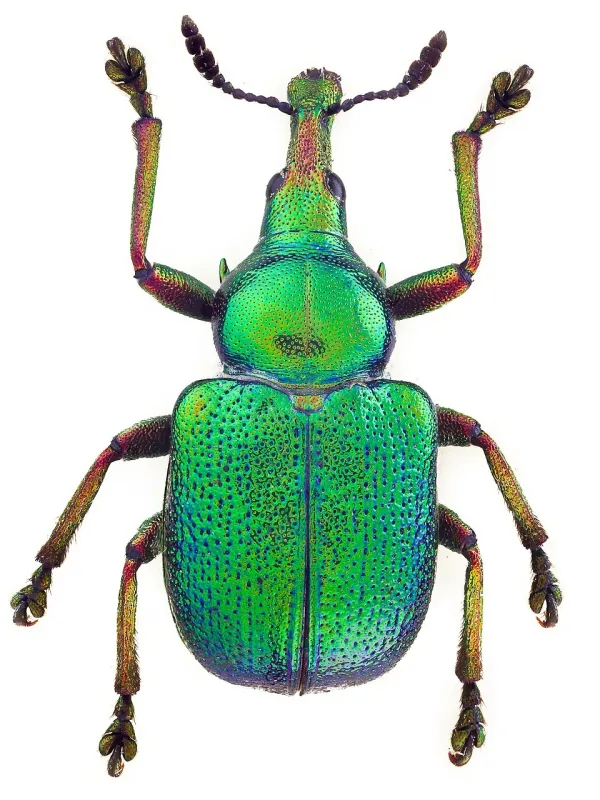
The Grape weevil (Byctiscus congenor) is a species of beetle belonging to the Attelabidae family. Adults are small, measuring 6–9 mm in length, and are easily recognized by their brilliant metallic green or golden-blue coloration.
The beetle features a distinct rostrum (snout) characteristic of the weevil family. Its body is oval-shaped and highly sensitive to vibrations; when disturbed, the insect often drops to the ground and plays dead to evade predators.
The larvae are legless, C-shaped, and creamy-white in color with a dark, hardened head capsule. They spend their entire developmental phase inside rolls of vine leaves crafted by the adult female.
The pest relies on the host plant for both shelter and nutrition. Adults overwinter in the soil or under leaf litter, emerging in early spring when the air temperature becomes conducive to plant growth.
Proper identification is crucial for effective management, as the visible signs of leaf rolling distinguish this species from other common vine-feeding insects.
What it damages
The Grape weevil attacks grapevines during multiple stages of the season. Damage is caused by both adults, which feed on buds and leaves, and larvae, which develop inside the rolled foliage.
Early in the season, adult beetles consume developing buds. This can destroy the potential harvest before the season even begins, leading to significant yield loss and reduced vine vigor.
Later in the spring and summer, adults feed on the leaves, creating small, irregular holes. Heavy infestation can lead to partial defoliation and disrupted photosynthesis, weakening the vine's overall health.
Larval feeding is particularly destructive, as the larvae consume the internal tissues of the tightly rolled leaves. This causes the leaves to brown, wither, and drop prematurely.
Severe infestations interfere with the accumulation of sugars in the berries and prevent the proper hardening of vine shoots, making the vineyard more susceptible to frost and secondary pathogens.
When it appears
The life cycle begins in early spring when adults emerge from their overwintering sites in the soil or protected organic debris to feed on emerging buds.
Mating and egg-laying occur during the period of rapid leaf development. Females exhibit a specialized behavior of cutting and rolling leaves to create a protected environment for their eggs.
The larval stage occurs primarily during the late spring and early summer. The larvae feed within the leaf rolls, reaching maturity in about 3 to 4 weeks before pupating.
The new generation of adults usually appears in mid-summer. These beetles engage in supplementary feeding on the foliage before seeking suitable spots for hibernation.
By late autumn, the beetles retreat into the soil or deep leaf litter to undergo diapause, preparing for the upcoming winter season.
Signs of infestation
The most early sign of infestation is damaged or "hollowed-out" buds that fail to develop properly or show visible holes from beetle feeding.
The most distinct visual indicator is the presence of "leaf cigars"—tightly rolled grape leaves hanging from the shoots. These are clear nurseries for the developing larvae.
The leaves that have not yet been rolled often display "shot-hole" damage or irregular tissue removal caused by the adults' mouthparts.
Premature leaf drop in early summer, especially when the fallen leaves are curled and brown, is a strong diagnostic sign of a high population density of the Grape weevil.
Monitoring can be performed by gently shaking the vine over a sheet during the early morning hours, which causes the beetles to drop and become visible for counting.
Control measures
Cultural control is highly effective and involves the systematic collection and destruction of fallen, curled leaves to eliminate larvae before they reach the pupation stage.
Deep cultivation of the soil around the base of the vines in autumn disrupts the overwintering sites and exposes the beetles to environmental stress or predation.
Hand-picking of adult beetles during the early morning hours can significantly reduce the population in small-scale vineyards or home gardens.
Chemical intervention should be timed to match the beetles' peak activity, specifically during the bud-burst phase and immediately following the completion of bloom.
- Apply systemic or contact insecticides registered for viticulture use.
- Encourage natural predators such as birds and ground beetles in the vineyard.
- Maintain sanitation to reduce hiding spots for the pest population.
Taxonomy
- Latin name
- Byctiscus congenor
- Order
- Coleoptera (beetles)
- Family
- Attelabidae
- EPPO code
- BYCTCO
Discussion
No discussions yet — be the first.