
Oak leaf roller beetle
Attelabus nitens
Description
How to identify
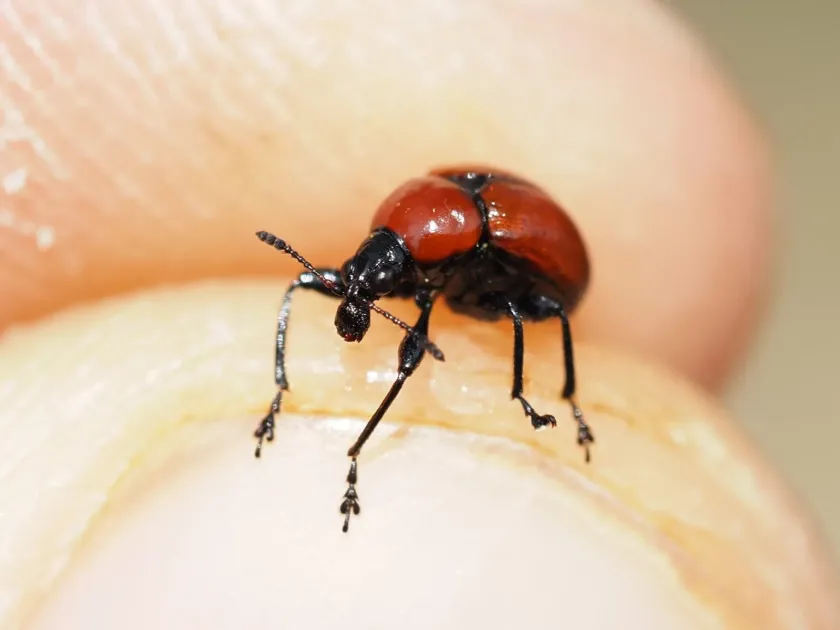
The oak leaf roller beetle (Attelabus nitens) is a member of the Attelabidae family within the order Coleoptera. Adult beetles are easily recognizable by their brilliant reddish or brick-colored bodies and black heads.
Measuring between 4 and 7 mm in length, these beetles have a stout, compact body. Their most notable feature is the extended snout, which allows them to manipulate leaf tissue with high precision during the construction of their nests.
The life cycle follows complete metamorphosis, including egg, larval, pupal, and adult stages. The larvae are small, legless, and white, hidden within the safety of the rolled leaf structures.
Their taxonomy is well-documented in entomology. They are specifically adapted to deciduous forests where oak trees are abundant, as the oak leaves provide the ideal material for their rolling activity.
These beetles are wary creatures. During the day, if disturbed while sitting on a leaf, they will often fold their legs and drop from the tree, making them difficult to spot without close observation.
What it damages
The primary hosts for Attelabus nitens are trees of the genus Quercus (oaks). They target young saplings and shoots where the leaves are young, soft, and easy to roll.
While oak is their preferred habitat, they can occasionally be found on hazel, beech, or chestnut. However, the damage to these secondary hosts is generally minor compared to the impact on oaks.
The damage is two-fold: the adult beetle consumes leaf tissue for nutrition, and the female cuts the leaf to create the nest, which disrupts the leaf's normal photosynthetic functions.
Widespread activity can lead to premature leaf drop, which can be detrimental to the vigor of young trees, especially during dry summers or in nurseries where growth is essential.
In ornamental garden settings, the unsightly presence of rolled, dried leaves significantly impacts the aesthetic value of the trees and can be a source of frustration for garden owners.
When it appears
The seasonal activity begins in late spring, specifically in May or June, as soon as the oak leaves have fully unfolded. This is the prime time for mating and nesting.
The adult beetles remain active through the early part of the summer. During this period, a single female can construct multiple leaf rolls, ensuring the survival of her offspring.
Inside these leaf cradles, the larvae grow and consume the interior tissue of the roll. They pupate within these structures, remaining protected from predators and environmental hazards.
The new generation of adults emerges in late summer, usually around August. These young beetles will feed for a period before seeking out wintering sites in the soil or leaf litter.
Overwintering occurs in the adult stage. The beetles bury themselves in the topsoil or under thick layers of forest debris to survive the cold winter months until spring returns.
Signs of infestation
The most diagnostic sign of an infestation is the presence of tightly rolled leaf structures, often referred to as "leaf cigars." These rolls hang from the branches or cover the forest floor.
Observing jagged edges on leaves that are not yet rolled indicates that adults are actively feeding in the canopy. These notches are distinct from other insect damage.
If you pick up a fallen leaf roll and carefully unroll it, you will likely find the larva or the pupa of the beetle, confirming the identity of the pest.
- Cigar-shaped leaf rolls attached to twigs.
- Small, rhythmic notches or holes on healthy leaves.
- Sudden shedding of curled leaves during late spring.
A high number of these rolls on the ground under a single tree is a clear indicator of a significant population of Attelabus nitens in that location.
Control measures
In large forest areas, active control is rarely necessary as natural cycles and predators keep the population in check, and the damage is usually considered cosmetic for established trees.
For nurseries or prized specimen trees, the most effective method is physical removal. Collecting and destroying fallen leaf rolls before the new adults emerge prevents the next generation.
Chemical control, such as applying contact insecticides, is only recommended in severe infestations where sapling development is threatened. Timing application for early spring is critical.
Promoting a healthy ecosystem is a long-term solution. Encouraging birds and parasitic wasps that target larvae will help maintain a natural balance without the need for synthetic chemicals.
Cleaning up debris and leaves under the trees in late autumn significantly reduces the number of successful wintering sites for the beetles, lowering the infestation pressure for the following year.
Taxonomy
- Latin name
- Attelabus nitens
- Order
- Coleoptera (beetles)
- Family
- Attelabidae
- EPPO code
- ATTLNI
Discussion
No discussions yet — be the first.