
Oak leaf roller
Attelabus
Description
How to identify
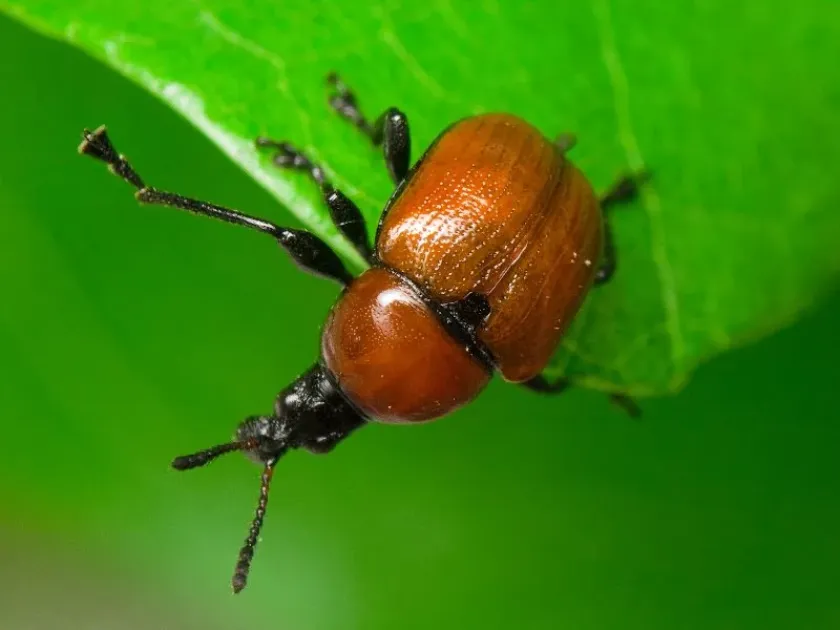
The oak leaf roller (Attelabus nitens) is a small beetle belonging to the Attelabidae family. Adult specimens typically measure between 4 and 6.5 mm in length, possessing distinctive bright red elytra and a black head equipped with a characteristic elongated snout.
Larvae are white, crescent-shaped, and wrinkled, with a well-developed dark head capsule. They are biologically adapted to feed exclusively within the leaf structures prepared by the female, which serve as both protection and a nutritional substrate.
The insect follows a single annual generation cycle. Adults overwinter in the leaf litter or soil beneath the host trees, emerging during the warming spring days to begin their maturation feeding and subsequent reproductive activities.
Reproduction involves a complex behavior: the female cuts the leaf vein, causing the leaf to wilt slightly, and then rolls it into a tight, cigar-shaped structure where she deposits her eggs. This structure protects the larvae throughout their development.
These beetles are most easily identified by their signature architecture. The presence of tightly rolled, blackened leaves hanging from branches or littering the ground is the most obvious sign of an infestation in an oak-dominant environment.
What it damages
The primary host for this species is the pedunculate oak (Quercus robur). However, in high-density populations, the beetle may also infest other broad-leaved species such as hazel or beech trees, depending on local availability.
Both adults and larvae cause damage. Adults consume the leaf tissue, creating small holes, while the larvae feed on the internal parts of the rolled leaves, eventually consuming the tissue until only the skeletal vein network remains.
Severe infestations lead to significant defoliation of the crown. While established mature trees can withstand a certain level of leaf loss, young trees in nurseries and forest plantations suffer reduced vigor and growth suppression.
The physiological stress caused by the destruction of leaf area affects the tree's ability to store energy for the winter. Repeated infestations over several years can make trees more susceptible to secondary pests and fungal pathogens.
In nursery settings, the aesthetic and developmental damage is particularly high, as the destruction of leaves during the critical growth phase in late spring significantly stunts the development of young saplings.
Signs of infestation
The hallmark sign of an infestation is the presence of cylindrical, cigar-shaped leaf rolls. These structures are distinct, tightly sealed, and can be found either hanging on branches or on the forest floor.
Early season feeding damage by adults appears as small, circular or irregular holes in the leaves. This feeding precedes the rolling process and is a key indicator that the infestation phase has begun.
Premature leaf wilting and shedding are common symptoms. Since the female damages the petiole to induce wilting before rolling, large numbers of prematurely fallen leaves in early summer suggest heavy activity.
If a rolled leaf is opened, one can typically find the larvae or the remnants of their feeding. The interior of the roll will be discolored and partially decomposed, reflecting the larvae's feeding habits.
An overall thinning of the foliage, particularly on the outer branches of the oak, is often observed when the population density reaches a peak, resulting in a sparse, unhealthy crown appearance.
Control measures
The most effective management strategy is the mechanical collection and destruction of the rolled leaves. By removing these before the adults emerge, you effectively reduce the population for the following season.
In cases of severe infestation, systemic or contact insecticides can be applied during the early spring when adults emerge for feeding. Proper timing is crucial to prevent the leaf-rolling phase of the life cycle.
Cultural practices such as shallow cultivation or loosening the soil beneath the trees in autumn can disrupt the overwintering pupae and larvae, leading to higher mortality rates due to exposure.
Biological control using entomopathogenic fungi or beneficial nematodes applied to the soil can offer an environmentally friendly alternative to chemical treatments in sensitive parklands or gardens.
- Conduct regular crown inspections throughout the spring months.
- Collect and burn all fallen leaf rolls to stop the life cycle.
- Ensure trees are well-watered and fertilized to improve natural resistance.
Taxonomy
- Latin name
- Attelabus
- Order
- Coleoptera (beetles)
- Family
- Attelabidae
- EPPO code
- ATTLSP
Discussion
No discussions yet — be the first.