
Persimmon thrips
Ponticulothrips diospyrosi
Description
How to identify
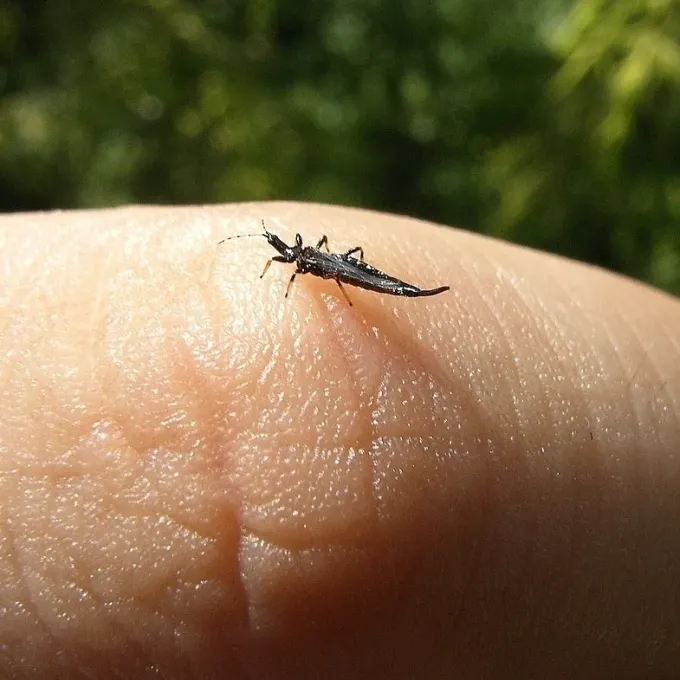
Persimmon thrips (Ponticulothrips diospyrosi) is a small insect belonging to the order Thysanoptera, specifically the Phlaeothripidae family. It is a specialized pest that exclusively targets persimmon trees (Diospyros spp.).
Adults are typically dark brown or black in color and measure approximately 2–3 mm in length. They possess feathery wings, which are characteristic of the thrips order, allowing them to fly between branches and trees during warm weather.
The life cycle of this pest includes several stages: egg, larval stages, pupal stages, and adult. Each stage is adapted to the specific conditions provided by the host plant's foliage.
Because they are small and prefer to hide inside curled leaves, they are often difficult to detect during the early stages of infestation. Identifying their presence requires careful examination of new growth and terminal buds.
This species is well-adapted to the environments where persimmons are grown, often thriving in sheltered areas of the tree canopy where they are protected from natural predators.
What it damages
The primary damage caused by persimmon thrips is the result of their feeding behavior. Both larvae and adults pierce plant tissues and suck cell sap, which causes the leaf tissue to lose its vitality.
The most visible sign of damage is the curling of young leaves, which roll inward to form protective tubes. This prevents the leaf from expanding properly and significantly reduces its ability to perform photosynthesis.
As the plant loses nutrients and water through these punctures, growth slows down, and in severe cases, the shoots become stunted or deformed. This is particularly harmful to young nursery trees that need to establish strong growth.
Heavy infestations can lead to premature leaf drop, which weakens the overall health of the tree and reduces the carbohydrate reserves needed for fruit production and winter survival.
In addition to foliage damage, thrips may also feed on developing buds and flowers, resulting in poor fruit set or deformities in the fruit skin, which ruins the aesthetic value of the harvest.
When it appears
The activity of persimmon thrips begins in early spring, coinciding with the bud break of the persimmon trees. As the first leaves appear, the overwintered adults emerge to begin feeding and laying eggs.
Throughout the summer, the population grows rapidly. Due to the favorable high temperatures, the thrips can complete multiple generations in a single growing season, leading to a constant cycle of infestation.
The population reaches its peak during the hottest, driest months of the year, which accelerate the life cycle and increase the damage potential per unit of time.
As autumn approaches and temperatures drop, the thrips prepare for hibernation. They seek refuge in bark crevices, dry leaves, or other sheltered spots on or near the host plant.
The success of the pest over the winter depends on the availability of suitable overwintering sites, making sanitation an important part of managing their annual cycle.
Signs of infestation
The hallmark sign of a persimmon thrips infestation is the presence of curled, rolled-up leaves on the terminal shoots. These curled leaves act as nests for the pest population.
If you unroll an affected leaf, you will observe the insects, along with small black spots of excrement, which are diagnostic indicators of thrips presence.
On the outer surface of the leaves, feeding activity manifests as tiny silvery or light-colored flecks where the cells have been drained of their contents.
Stunted development of the branch tips is a strong indicator of a long-term infestation. Branches may appear twisted or bushier than normal due to the damage sustained by the growing point.
General tree stress, such as yellowing leaves and a lack of vigor, can occur in cases where the infestation covers a significant portion of the tree canopy.
Control measures
Effective management of persimmon thrips requires a multi-faceted approach. Cultural practices, such as the pruning and disposal of infested shoots, help reduce the immediate population pressure.
Chemical control is often necessary during peak seasons. Systemic insecticides are generally preferred as they travel through the plant's vascular system, reaching the hidden thrips inside the curled leaves.
Monitoring using colored sticky traps (usually blue or yellow) is an excellent way to track the emergence of adults and time the application of treatments for maximum effectiveness.
Encouraging natural predators, such as predatory mites and lady beetles, can help keep the population in check, although this is usually insufficient for severe outbreaks.
- Implement a regular pruning schedule to remove heavily infested areas.
- Ensure adequate irrigation to keep the trees healthy and resilient against stress.
- Rotate chemical products to avoid the development of insecticide resistance.
Taxonomy
- Latin name
- Ponticulothrips diospyrosi
- Order
- Thrips
- Family
- Phlaeothripidae
- EPPO code
- PONLDI
Discussion
No discussions yet — be the first.