
Mullein thrips
Neoheegeria verbasci
Description
How to identify
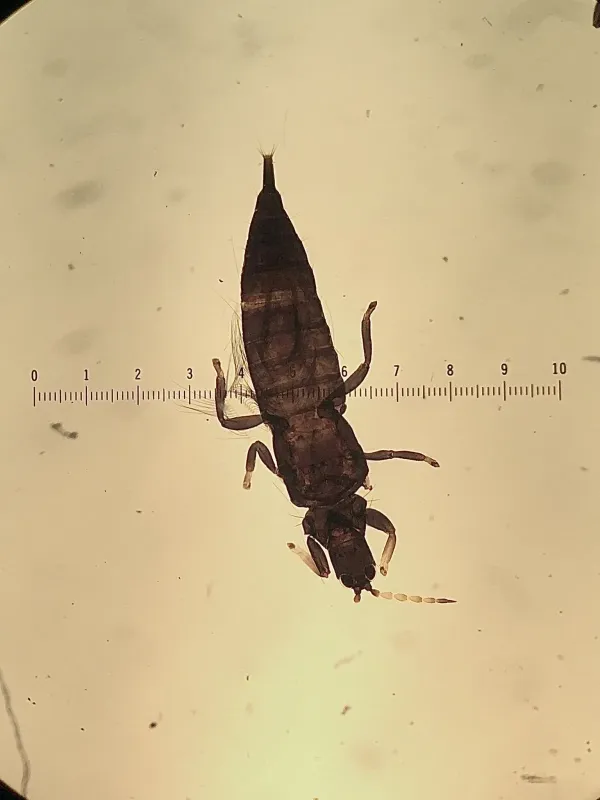
Mullein thrips (Neoheegeria verbasci) belong to the order Thysanoptera, family Phlaeothripidae. The adult insect has an elongated body measuring approximately 2-2.5 mm, typically dark brown or nearly black in color.
This species is characterized by the presence of a tube on the last abdominal segment, which is a distinctive feature of the suborder Tubulifera. The wings are narrow with long fringes, allowing for active flight during warm and sunny conditions.
The larvae are generally lighter in color, often exhibiting reddish or yellowish tones. They have soft bodies and lack wings, preferring to remain hidden within flower spikes or on the underside of leaves.
The life cycle includes stages of egg, larva (two instars), prepupa, pupa, and adult. Unlike many other thrips species, this pest shows a high degree of specificity to certain host plants within the Scrophulariaceae family.
Adults overwinter in plant debris, under fallen leaves, or in the topsoil layer, where they remain dormant until favorable temperatures return in the spring.
What it damages
The primary host plant for this pest is the Mullein (Verbascum), from which its common name is derived. Thrips congregate mainly in the inflorescences and on young, tender leaves of the plant.
During outbreaks, this pest can spread to other related plants in the Scrophulariaceae family if they are growing nearby. This makes them a potential threat to various ornamental garden species.
Damage is caused by both adults and larvae as they pierce plant tissues and suck out cell sap, which disrupts the normal metabolic processes of the affected plant parts.
Tissue damage often manifests as necrosis, deformation of the inflorescences, and premature shedding of flower buds, significantly reducing both the aesthetic value and seed production of the Mullein.
Damaged plant tissues frequently become susceptible to secondary infections, such as fungal pathogens, which colonize the injury sites and areas contaminated by the pest's frass.
When it appears
Mullein thrips activity begins in late spring when ambient temperatures consistently rise above 15°C. Population peaks are usually observed during the Mullein flowering period.
During the summer, if weather conditions are favorable, the pest can produce several generations. Hot and dry weather typically accelerates the developmental cycle and increases the population density.
Activity levels decline toward late summer and autumn. As average daily temperatures drop, adults begin searching for suitable overwintering sites.
The duration of a single generation's life cycle is highly dependent on the local climate, averaging between 3 to 5 weeks during a warm summer.
Environmental factors, such as heavy rain, can temporarily suppress thrips populations by physically washing larvae off the plants and increasing humidity, which is detrimental to certain developmental stages.
Signs of infestation
The first sign of infestation is the appearance of silvery or light-colored streaks and spots on the leaves, which eventually merge into large necrotic patches caused by chlorophyll destruction.
Inflorescences often appear stunted; buds may fail to open fully or become distorted. Heavy infestations frequently result in the premature wilting of flowers.
Black frass (excrement) from the pest is often visible on the leaf surface and within the flower spikes, appearing as tiny dark specks, which serves as a reliable indicator of a thrips colony.
- Distortion of terminal shoots and flower spikes.
- Presence of small, active insects when shaking flower heads over a sheet of white paper.
- Widespread chlorotic zones on foliage.
With close inspection using a hand lens, individuals can easily be found hiding deep within the flower base or between bracts, away from direct sunlight.
Control measures
The primary control measure is an agrotechnical approach: timely removal and destruction of plant debris in the autumn to eliminate overwintering sites and reduce the pest load for the following season.
The use of biological insecticides based on entomopathogenic fungi (e.g., Beauveria bassiana) has shown high efficacy in residential gardens when applied during cool morning or evening hours.
Chemical control involves the use of systemic insecticides capable of penetrating plant tissues. Products based on organophosphates or neonicotinoids are often effective when applied at the onset of flowering.
It is crucial to rotate insecticides from different chemical classes to prevent the development of resistance, which is a common challenge in managing thrips populations.
Regular monitoring of plantings using yellow sticky traps allows for early detection of pest migration, enabling preventative treatments before a full-scale infestation occurs.
Taxonomy
- Latin name
- Neoheegeria verbasci
- Order
- Thrips
- Family
- Phlaeothripidae
- EPPO code
- HAPLVE
Discussion
No discussions yet — be the first.