
Myoporum thrips
Klambothrips myopori
Description
How to identify
Myoporum thrips (Klambothrips myopori) is a small insect belonging to the order Thysanoptera and the family Phlaeothripidae. It is a highly specialized pest primarily known for affecting Myoporum species.
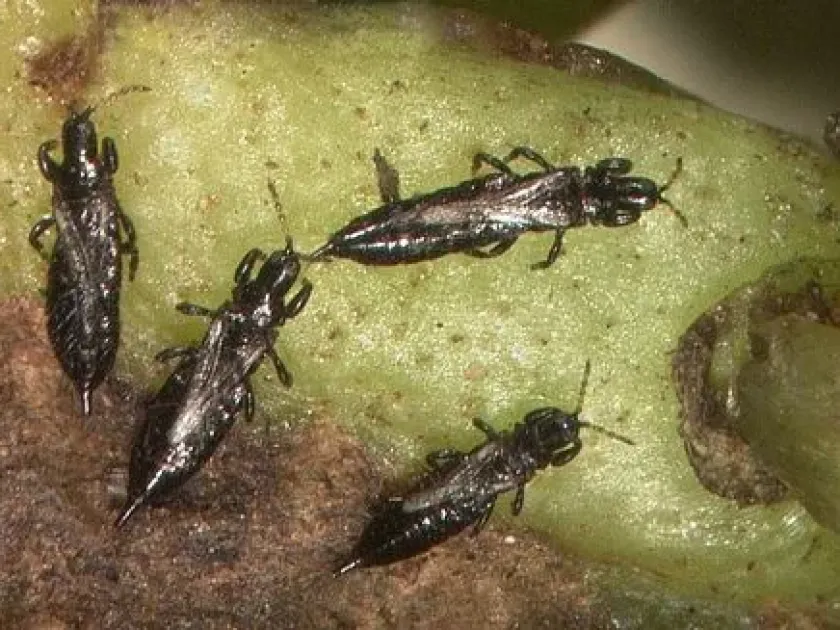
Adult insects are tiny and dark in color, making them difficult to spot without close inspection. They possess long, slender bodies and characteristic fringed wings typical of their order.
The life cycle consists of egg, larval, prepupal, pupal, and adult stages. The insect spends the majority of its life cycle hidden within protected areas of the plant.
Unlike generalist thrips, Klambothrips myopori focuses its activity on specific host plants, leading to concentrated populations on developing foliage.
The population growth is rapid during warm seasons, as the favorable climate allows for multiple generations to develop in a short timeframe.
What it damages
The primary host for this pest is the Myoporum shrub, which is often used as a groundcover or ornamental plant in landscaping.
Feeding occurs on the undersides of leaves and at the growing tips. The insects pierce plant tissues and suck out the cellular contents, which disrupts normal development.
The damage causes severe curling and twisting of the leaves. This deformation makes the plant look stunted and unhealthy, ruining its aesthetic value.
When the infestation is heavy, the terminal growth of the branches stops completely, leading to the distortion of the entire structure of the plant.
Furthermore, constant feeding weakens the plant, making it less vigorous and more susceptible to environmental stressors and secondary diseases.
Signs of infestation
The most distinctive symptom is the severe curling of leaves into tight rolls or galls. These galls provide a protective environment for the colony.
Inside the rolled leaves, you can find adult thrips, larvae, and small, dark fecal spots left by the insects as they feed on the tissue.
The leaves often lose their green color, turning yellow or developing reddish patches due to the destruction of chlorophyll cells.
In advanced cases, the tips of the shoots appear brown, brittle, and highly distorted, preventing the plant from producing new, healthy leaves.
Early identification is key, as the damage becomes much more difficult to reverse once the leaf tissues have been permanently scarred and curled.
Control measures
Controlling Myoporum thrips requires a persistent effort. The first step involves physical removal of the infested plant parts to reduce the pest population.
Systemic insecticides are the most effective chemical control, as they are absorbed by the plant and kill the thrips feeding inside the curled leaves.
It is important to time insecticide applications during the active growing season when new leaves are being produced to prevent further colonization.
- Monitor plants regularly for early signs of leaf curling.
- Prune and destroy heavily infested branches to limit the spread.
- Use integrated pest management strategies to support natural predators.
For successful eradication, repeat treatments may be necessary to ensure that emerging nymphs are eliminated, as eggs are often protected from contact sprays.
Taxonomy
- Latin name
- Klambothrips myopori
- Order
- Thrips
- Family
- Phlaeothripidae
- EPPO code
- KLAMMY
Discussion
No discussions yet — be the first.