
Karnyothrips melaleucus
Karnyothrips melaleucus
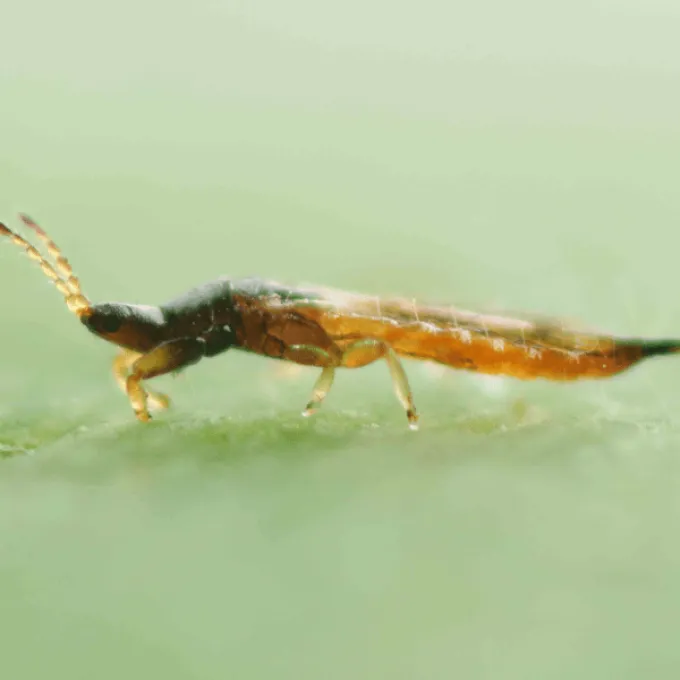
Description
How to identify
Karnyothrips melaleucus belongs to the order Thysanoptera and the family Phlaeothripidae. These insects are characterized by a slender body and piercing-sucking mouthparts used for feeding on plant fluids.
Adults typically exhibit a dark coloration, often with distinct lighter markings on their wings or legs, consistent with their specific name melaleucus. They are highly mobile and capable of flight under favorable environmental conditions.
The life cycle encompasses egg, two larval stages, prepupa, pupa, and adult. Unlike many strictly herbivorous thrips, this species sometimes displays predatory behavior towards other small arthropods.
Their development is heavily influenced by temperature and humidity levels, with warm climates significantly shortening the duration of their life stages and increasing reproductive rates.
Due to their minute size, identification requires careful inspection using a hand lens or collecting them with an insect net for microscopic examination in a laboratory setting.
What it damages
This pest affects a wide range of host plants, including various fruit trees, shrubs, and ornamental species. They are often found inhabiting bark crevices and leaf litter.
The primary damage is caused by both larvae and adults piercing the epidermis of leaves and stems to extract cell contents, leading to localized tissue death.
Initial feeding causes the formation of chlorotic spots, which eventually merge, leading to necrosis and premature senescence of the foliage, thereby reducing photosynthetic capacity.
Karnyothrips melaleucus can act as a vector for various plant pathogens, potentially transmitting viruses or fungi through the micro-wounds created during feeding.
Severe infestations can lead to stunted growth of new shoots, deformation of flowers, and significant reduction in both yield and the aesthetic value of the plants.
When it appears
The activity of Karnyothrips melaleucus commences in early spring as temperatures rise, signaling the emergence of overwintered adults from their dormant sites.
During the summer months, higher temperatures facilitate rapid population growth, often resulting in several overlapping generations within a single growing season.
As autumn approaches and temperatures drop, the insects seek protected environments, such as bark cracks or debris, to undergo hibernation as adults.
Overwintering adults exhibit high levels of cold tolerance, allowing them to survive in sheltered niches until the following spring season begins.
Regular monitoring throughout the growing season is essential, utilizing sticky traps and periodic plant inspections to detect population increases before they cause significant damage.
Signs of infestation
The first signs of an infestation often include a characteristic silvery or bleached appearance on the leaf surface, caused by the destruction of epidermal cells.
Small black or dark spots on the underside of leaves represent fecal deposits left by the thrips, which are a strong diagnostic indicator of an active population.
Curling or twisting of young leaves and deformed terminal buds are common symptoms of localized feeding pressure that warrants immediate management action.
In flowering plants, the damage may manifest as browning, wilting, or premature dropping of blooms, which negatively impacts the reproductive success of the plant.
Visual detection can be confirmed by gently tapping plant parts over a sheet of white paper, which allows for the observation of the tiny, moving insects.
Control measures
Cultural control measures include the removal of weeds and plant debris, which serve as alternative hosts and overwintering sites for the thrips population.
Implementing effective crop rotation and maintaining spatial isolation between susceptible plant varieties help to prevent the spread of the pest across agricultural fields.
Chemical control involves the application of systemic or contact insecticides registered for use on the specific crop, applied at the first sign of significant infestation.
It is vital to rotate insecticides with different modes of action to prevent the development of resistance within the thrips population due to their rapid reproductive cycle.
Biological control methods, such as the introduction of predatory mites or bugs, can be highly effective in greenhouse environments and integrated pest management programs.
Taxonomy
- Latin name
- Karnyothrips melaleucus
- Order
- Thrips
- Family
- Phlaeothripidae
- EPPO code
- KARNME
Discussion
No discussions yet — be the first.