
Oxeye daisy thrips
Haplothrips leucanthemi
Description
How to identify
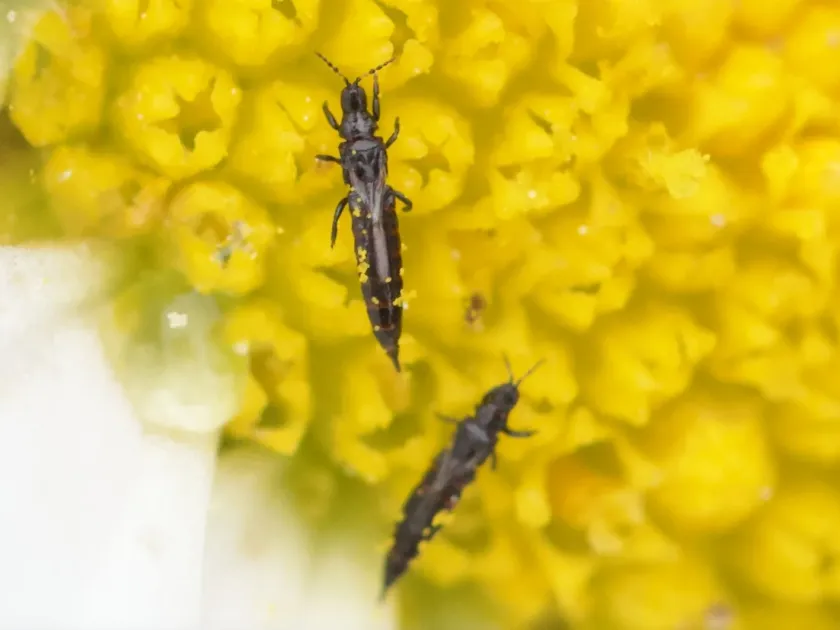
The Oxeye daisy thrips (Haplothrips leucanthemi) is a member of the Phlaeothripidae family within the Thysanoptera order. Adults are small, elongated insects typically measuring around 2 to 2.5 mm in length.
The adult body color ranges from dark brown to black. They possess transparent wings with a distinct fringe, which are tucked along the back when the insect is at rest.
Larvae appear lighter in color, often exhibiting shades of yellow or reddish tones depending on their developmental stage and current food source.
The life cycle encompasses several stages: egg, larva, prepupa, pupa, and adult. This incomplete metamorphosis allows for rapid population growth in favorable conditions.
Identification is primarily performed by observing the specific structure of the mouthparts and antennae, which are distinct for this species when viewed under laboratory magnification.
What it damages
This pest primarily attacks plants in the Asteraceae family, with oxeye daisies (Leucanthemum vulgare), chrysanthemums, and various ornamental species being the most susceptible.
The damage is caused by both adults and larvae feeding on the cell sap of the plant tissues within the flower heads and buds.
Feeding activities result in silvering, deformation, and discoloration of the petals, which severely compromises the aesthetic value of the ornamental crops.
In addition to cosmetic damage, the thrips feed on reproductive organs, which inhibits seed development and reduces the overall yield of seed-producing plants.
Furthermore, feeding damage can create entry points for opportunistic fungal pathogens, leading to secondary infections and premature decay of the flowers.
When it appears
Adult thrips emerge from overwintering sites during the early growth stages of host plants, typically when temperatures consistently exceed 15 degrees Celsius.
The peak activity and reproductive phase occur during the hot and dry summer months, which promote faster development and multiple generations per season.
Population densities tend to increase significantly as the summer progresses, leading to more severe infestation levels in late-season flowers.
Overwintering occurs as adults, seeking refuge in plant debris, soil, or crevices in bark, where they remain inactive until the return of warmer weather.
In protected greenhouse environments, the pest can continue its reproductive cycle year-round if proper food sources and moderate temperatures are available.
Signs of infestation
Early symptoms include tiny white or silver spots on the petals, which eventually merge into large, necrotic areas as the infestation progresses.
Flower buds often fail to open properly, resulting in twisted or stunted blossoms that look visually distorted.
The presence of minute black fecal spots on the petals is a telltale sign of heavy thrips activity and ongoing feeding within the flower head.
Inspecting the inner parts of the flowers frequently reveals the pests moving rapidly within the crowded environment of the florets.
Tapping an infested flower onto a white sheet of paper will typically dislodge the insects, making them easy to spot against the light background.
Control measures
Effective management starts with rigorous weed control, specifically removing Asteraceae weeds that serve as early-season reservoirs for the pest.
Cultural practices such as deep autumn soil cultivation and the thorough removal of plant debris help eliminate overwintering populations.
Monitoring using yellow or blue sticky traps is essential for detecting early immigration and determining the optimal timing for intervention.
Chemical control should be implemented only when necessary, using systemic or contact insecticides registered for use on ornamental flowers, ensuring proper rotation to prevent resistance.
- Introduce biological control agents like predatory mites or bugs.
- Maintain adequate irrigation to reduce plant stress.
- Use spatial separation between susceptible crop varieties.
Taxonomy
- Latin name
- Haplothrips leucanthemi
- Order
- Thrips
- Family
- Phlaeothripidae
- EPPO code
- HAPLLE
Discussion
No discussions yet — be the first.