
Cuban laurel thrips
Gynaikothrips ficorum
Description
How to identify
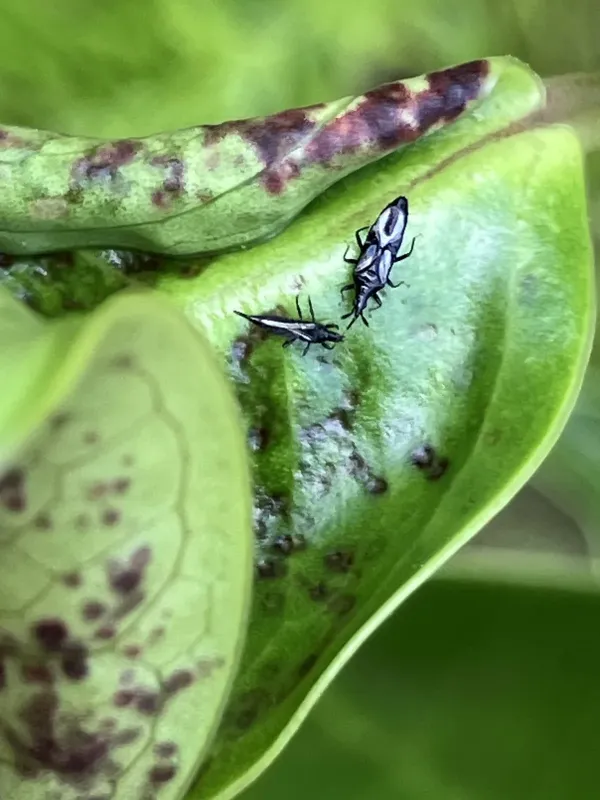
The Cuban laurel thrips (Gynaikothrips ficorum) is a member of the Phlaeothripidae family within the order Thysanoptera. These are minute, slender insects typically exhibiting a black or dark brown body color.
The life cycle encompasses several stages: egg, larva, prepupa, pupa, and adult. Under warm conditions (25-30°C), the entire cycle can be completed in about three to four weeks.
Females insert eggs into the tender tissues of young, emerging leaves, which ensures that larvae have immediate access to food and shelter.
The insects are primarily hidden inside leaf rolls or galls, making their detection difficult until significant damage has already occurred.
Adult thrips are capable of flight, which facilitates their spread between individual plants within greenhouses or botanical collections.
What it damages
While the insect is most famous for attacking Ficus benjamina and Ficus microcarpa, it can infest various other members of the Ficus genus.
The feeding behavior of both adults and larvae triggers the development of leaf galls, where the leaf margins curl inward, creating a protective enclosure.
Initially, these galls are light green, but they eventually turn reddish-brown or black, which serves as a tell-tale sign of a severe infestation.
The resulting physiological stress leads to leaf drop, stunted shoot development, and a significant reduction in the aesthetic appeal of the plant.
In addition to direct damage, the plant's weakened state invites secondary pathogens, such as fungi, which may colonize the damaged tissues.
Signs of infestation
The most distinctive symptom is the presence of galls — rolled, curled, or distorted leaves that protect the thrips colonies from the environment.
When these galls are opened, you will see the adult thrips and larvae moving inside, often accompanied by black fecal spots on the leaf surface.
Stippling or silvering on the leaf surface, resulting from the destruction of individual plant cells during feeding, is a common early observation.
Terminal buds may stop growing or appear blackened and necrotic as the infestation intensity increases over time.
A sticky or shiny residue on the foliage may sometimes be observed, often linked to the presence of secondary secretions or associated fungi.
Control measures
Effective management requires a combination of cultural practices and chemical interventions to suppress population growth.
Systemic insecticides are generally the most effective approach because they are absorbed into the plant, reaching the pests protected within the leaf galls.
Physical removal of infested leaves is critical to reduce the population pressure on the plant; these should be destroyed rather than composted.
Regular monitoring using yellow sticky cards can help detect the presence of adults before they cause extensive damage to the new growth.
- Regular inspection of new leaf growth.
- Pruning and disposal of heavily infested leaves.
- Application of systemic insecticides (e.g., imidacloprid-based).
- Maintaining plant health through adequate watering and light.
- Quarantining new plants before introducing them to the main collection.
Taxonomy
- Latin name
- Gynaikothrips ficorum
- Order
- Thrips
- Family
- Phlaeothripidae
- EPPO code
- GYNAFI
Discussion
No discussions yet — be the first.