
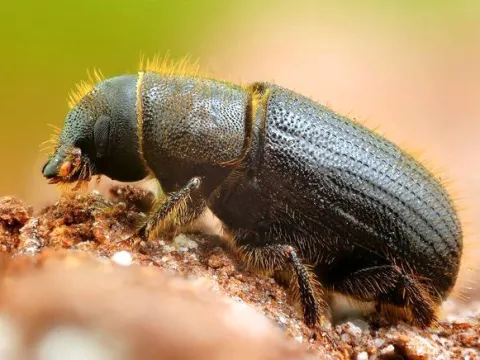
Wood-boring beetle
Xyloterus
The wood-boring beetle (genus Xyloterus) belongs to the order Coleoptera and the family Curculionidae. These are small, cylindrical insects typically ranging from 3 to 4 millimeters in length.
What the section contains
Wood-boring beetle
Their bodies are usually dark brown or black, providing excellent camouflage against tree bark. A distinctive feature is the pronotum, which completely covers the head when viewed from above.
Equipped with strong mandibles, these beetles are capable of boring deep into solid wood. They exhibit a complex life cycle, including complete metamorphosis: egg, larva, pupa, and adult.
Unlike many other bark beetles, these insects are known as ambrosia beetles because they cultivate specific fungi in their tunnels. These fungi serve as the primary food source for their larvae.
The larvae are white, legless, and have a distinct, hardened head capsule. They live within the galleries created by the adults, feeding on the fungal mycelium growing on the tunnel walls.
These beetles primarily target conifers such as spruce, fir, and pine, but can also infest deciduous trees like beech and birch. They typically favor weakened, felled, or freshly cut timber.
The damage is caused by the tunnels drilled deep into the wood, which disrupt the structural integrity of the timber and significantly lower its commercial value.
The introduction of ambrosia fungi into the tunnels causes discoloration of the wood, appearing as dark, permanent stains that make the timber unsuitable for high-quality carpentry.
Severe infestations can lead to a decline in tree health, making the trees more susceptible to secondary attacks by other pests or pathogenic fungi that accelerate wood decay.
In forest management, these beetles are considered serious pests because they can rapidly colonize large volumes of harvested timber if it is not processed or removed promptly.
Adult beetles emerge in the spring, typically from April to May, when daily temperatures reach 12-15 degrees Celsius. This is when the main flight period occurs.
Males initiate the attack by finding a suitable host and boring the entry hole. They release pheromones to attract females to the specific site.
After mating, females construct complex galleries inside the wood for egg-laying. The development of a single generation takes approximately two months under favorable conditions.
In warm climates or during particularly long summers, a second generation may occur, leading to a significant increase in the pest population by late summer.
They overwinter as adults, hiding in the bark of trees where they developed or in the forest floor litter, waiting for the first signs of spring to resume their activity.
The earliest indicator of an infestation is the presence of fine wood dust or "frass" accumulating at the base of the tree or within bark fissures.
Careful inspection reveals small, perfectly round entry holes, roughly 1-2 mm in diameter, which look as if they were drilled into the tree surface.
Removing a section of the bark exposes the galleries, which are typically branched and run perpendicular to the main axis of the trunk.
Dark, discolored stains on the wood are clear signs of ambrosia fungus activity, confirming that the beetles have successfully established their galleries.
Wilting of the canopy or a change in foliage color to yellowish-brown can indicate that the tree is heavily infested and its vascular system has been severely compromised.
The primary control method is silvicultural management, which involves the prompt removal of fallen or weakened trees from the forest to eliminate breeding grounds.
The use of "trap trees"—felled logs placed strategically to attract beetles—is an effective way to concentrate and destroy populations before they spread.
Pheromone traps are widely used for monitoring adult beetle activity and can help determine the timing for protective measures, such as insecticide applications.
For high-value trees or ornamental planting, systemic insecticides injected into the stem or applied as a bark spray can provide effective protection during the flight season.
- Regular forest sanitation to remove deadwood.
- Monitoring of timber piles for frass deposits.
- Biological control through the preservation of natural predators.