
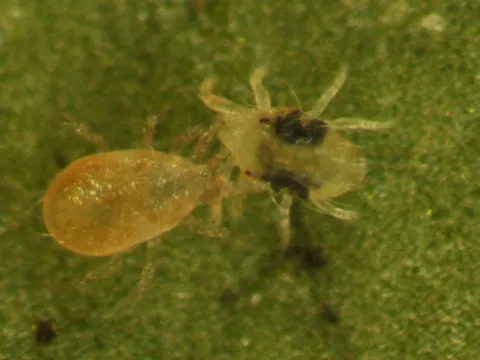
Typhlodromus caudiglans
Typhlodromus caudiglans
Typhlodromus caudiglans is a species of predatory mite belonging to the Phytoseiidae family. These mites are minute, typically reaching only a few hundred micrometers in length, making them difficult to observe with the naked eye.
What the section contains
Typhlodromus caudiglans
They are generally pale, translucent, or light tan in color. Under a microscope, they are identified by the specific arrangement of setae (bristles) on their dorsal shield, which is a key diagnostic feature for this species.
Their life cycle consists of an egg stage, followed by larval, protonymph, deutonymph, and adult stages. The duration of their development is highly sensitive to ambient temperature and the availability of prey.
These mites are highly mobile, actively patrolling the undersides of leaves and along the veins of host plants. Their hunting behavior is characterized by rapid movement and efficient tracking of herbivorous prey.
In various agricultural systems, they are recognized as key biological agents, serving as a natural defense mechanism against several types of damaging spider mites.
It is crucial to note that Typhlodromus caudiglans is not a plant pest; it is a highly beneficial predatory mite. It does not feed on plant tissues or sap, and therefore causes zero damage to crops.
Its diet consists almost exclusively of small plant-feeding mites, such as the European red mite and other spider mite species. It consumes both the eggs and the active stages of these pests, effectively limiting their population growth.
By preying on these herbivores, Typhlodromus caudiglans plays an essential role in maintaining ecological stability within orchards and vineyards. They act as a natural, self-sustaining control method.
When present in sufficient numbers, they can suppress outbreaks of harmful mites, reducing the need for chemical intervention. They are a sign of a well-balanced and healthy agrosystem.
In the absence of their preferred prey, these predators can occasionally survive on plant pollen, which allows them to remain in the orchard even when pest populations are low.
The activity of Typhlodromus caudiglans typically begins in early spring, synchronized with the onset of favorable temperatures and the start of plant growth. They emerge from overwintering sites to hunt and reproduce.
During the summer months, they reach their peak population density, which generally corresponds to the high-activity period of spider mites. This allows them to maximize their impact on pest suppression during critical growth stages.
As autumn approaches and temperatures decline, these mites seek out protected niches such as crevices in tree bark, bud scales, or leaf litter to survive the winter months.
They enter a state of diapause, a form of dormancy that allows them to withstand sub-zero temperatures. Their ability to successfully overwinter determines their population density for the following spring.
Understanding these phenological patterns is essential for growers who wish to manage their crops while preserving these beneficial organisms during peak spray seasons.
The primary management strategy for Typhlodromus caudiglans is conservation. Growers should implement integrated pest management (IPM) practices to ensure the survival and prosperity of these predators.
This includes avoiding the use of broad-spectrum pesticides that are toxic to beneficial mites. Whenever possible, choose narrow-spectrum products that specifically target pests while sparing predator populations.
Creating and maintaining natural refuges within the orchard, such as cover crops or hedgerows, provides critical shelter and alternative food sources for the mites during periods of prey scarcity.
Regular monitoring using magnifying tools is recommended to assess the balance between pest populations and predatory mites, ensuring that control decisions are based on economic thresholds rather than prophylactic schedules.
- Use selective acaricides to protect beneficial predator populations.
- Promote biodiversity by maintaining undisturbed vegetation zones.
- Monitor mite populations carefully before deciding on chemical treatments.
- Avoid spraying during the peak emergence times of predatory mites if possible.