
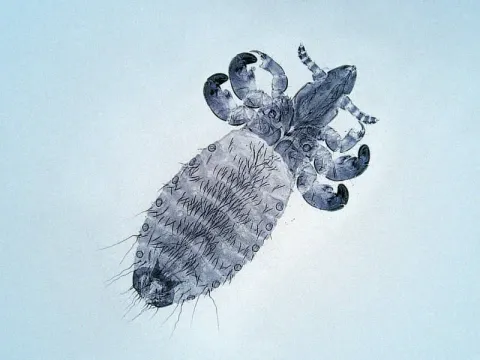
Dog biting louse
Trichodectes canis
The dog biting louse (Trichodectes canis) belongs to the order Mallophaga. It is a small, wingless insect typically measuring between 1 and 1.5 millimeters in length.
What the section contains
Dog biting louse
The insect possesses a flat, yellowish-brown body with a wide head adapted for chewing skin debris, hair, and secretions rather than piercing tissues.
The life cycle is completed entirely on the host animal, passing through stages of eggs, nymphs, and adults. Eggs are firmly cemented to the hair shaft.
This organism is strictly an ectoparasite of canines and is not categorized as an agricultural or horticultural pest.
There is no interaction between this species and agricultural crops, as it lacks the physiological capacity to feed on plant matter.
This louse species does not damage crops, grains, or any ornamental vegetation. It is strictly an animal welfare concern.
The damage caused by Trichodectes canis is restricted to the dermis of host animals, leading to irritation and discomfort.
It holds no significance in agronomy or plant pathology; it is classified solely within the field of veterinary entomology.
Environmental factors on farms do not support the survival of this louse, as it requires the constant body temperature of a mammalian host.
Farmers and agronomists do not need to implement any control measures for this species in the field or in storage facilities.
The most prominent sign of infestation is persistent itching and scratching by the host animal, often resulting in hair loss and secondary skin lesions.
Close inspection of the fur may reveal small, whitish oval eggs attached to individual hairs, which can resemble dandruff but are fixed in place.
Adult lice are often found in high concentrations around the head, neck, and the base of the tail where the skin is particularly sensitive.
The presence of these lice can serve as a vector for the canine tapeworm (Dipylidium caninum), posing a further health risk to the animal.
Affected pets typically show signs of restlessness, dull coat appearance, and localized inflammation of the skin surface.
Control is achieved exclusively through veterinary products such as topical insecticides, sprays, and oral medications approved for animal use.
Environmental sanitation, including cleaning bedding and grooming tools, is essential to interrupt the parasite's life cycle outside the host.
Agronomic pesticides intended for plant protection are strictly prohibited for use on animals due to their potential toxicity.
Effective management includes the simultaneous treatment of all animals in the household to prevent re-infestation of the host.
Professional veterinary consultation is recommended to select the appropriate treatment regimen tailored to the specific needs of the animal.