
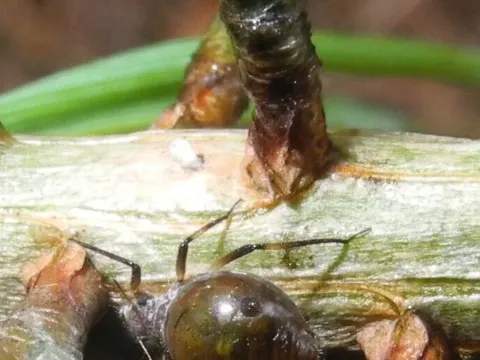
Giant spruce aphid
Todolachnus confinis
The giant spruce aphid (Cinara confinis), often referred to as Todolachnus confinis, is a large species of aphid belonging to the family Aphididae.
What the section contains
Giant spruce aphid
Adults are notably large, ranging from 4 to 6 mm in length, and are usually brownish or dark-grey, allowing them to camouflage perfectly against the spruce bark.
These insects tend to congregate in dense colonies on the trunks and branches of spruce trees, often found in clusters that look like dark patches on the tree surface.
They are characterized by high reproductive rates, allowing them to rapidly colonize host trees once environmental conditions become favorable in the spring.
The biological cycle involves both asexual reproduction during the growing season and sexual reproduction in the autumn to produce over-wintering eggs.
The primary hosts for this species are various spruce varieties (Picea species), which suffer significantly from the extraction of plant sap.
By piercing the bark to feed, the aphids deprive the tree of essential nutrients, leading to growth reduction, yellowing of needles, and branch dieback.
The infestation is often exacerbated by the excretion of honeydew, which serves as a breeding ground for sooty mold fungi that inhibit photosynthesis.
Young trees and those experiencing environmental stress due to drought or soil compaction are significantly more susceptible to serious damage.
If left unmanaged, heavy infestations can cause the tree to lose significant foliage, leading to a decline in aesthetic value and potential mortality in weak specimens.
Activity typically commences in early spring as soon as temperatures rise, signaling the hatching of the overwintering generation.
Population peaks usually occur during late spring and early summer when the sap flow in the trees is at its highest, providing abundant food for the aphid colonies.
As summer temperatures increase, the growth rate may plateau, although multiple generations can successfully complete their development throughout the season.
In late autumn, the aphids lay eggs in crevices of the bark, which remain dormant throughout the winter until the next spring.
Understanding these seasonal patterns is crucial for timing interventions, as the most effective control measures are applied during peak activity periods.
The most reliable sign of an infestation is the presence of ants, which frequently visit the aphid colonies to collect the sugary honeydew they produce.
Visual inspection often reveals dark, clustered masses on the branches and trunk, which are the aphids themselves feeding.
The development of a black, powdery sooty mold on the needles and bark is a clear indicator of the presence of honeydew-secreting insects.
Needle yellowing and premature shedding, especially on the lower branches of the tree, indicate that the tree is under significant physiological stress.
- Increased ant activity on the bark
- Presence of sticky honeydew on foliage
- Development of black sooty mold
- Yellowing and premature loss of needles
Systemic insecticides are the most effective method for controlling infestations, as they are absorbed by the tree and poison the aphids as they feed.
Applications should be timed correctly, targeting the colonies during the spring and early summer when the aphids are most active and vulnerable.
Managing ant populations around the base of the tree is essential, as ants protect the aphids from natural predators like ladybirds and lacewings.
For smaller infestations or decorative trees, manual removal combined with soap-based insecticidal sprays can provide temporary relief.
Maintaining the overall health of the tree through proper watering and soil management helps the spruce better withstand and recover from aphid damage.