
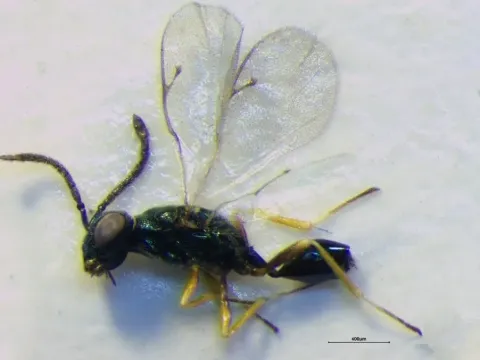
Sphegigaster solitarius
Sphegigaster solitarius
Sphegigaster solitarius is a member of the Hymenoptera order, family Pteromalidae. In agricultural environments, it is primarily recognized as a parasitoid insect.
What the section contains
Sphegigaster solitarius
The adults are small with a metallic luster, a typical characteristic of many Pteromalids. Their size and specialized biology make them difficult to spot without professional monitoring.
They possess specialized mouthparts and wing venation that are essential for identification under a microscope during field surveys or laboratory analysis.
The biology of this species is complex, as it is often associated with the larvae of dipterous pests that inhabit the stems or foliage of cultivated plants.
Identifying the presence of this insect is crucial for Integrated Pest Management (IPM), as it acts as a natural regulator of harmful insect populations.
Sphegigaster solitarius affects agriculture indirectly by influencing the population dynamics of primary pests like leafminers on cereal crops.
The host plants often include wheat and barley, where the insect searches for its prey within the plant tissues to lay its eggs.
While the insect itself does not cause significant mechanical damage to the foliage, the presence of its host can lead to reduced plant vitality if the parasite is not present.
Agricultural damage is often assessed based on the balance between the pest pressure and the regulatory capacity of existing entomophagous populations.
The economic impact is generally positive in a natural system, as the parasite reduces the damage caused by primary phytophagous insects.
The activity of the species peaks during the spring and summer months, corresponding with the vegetative stages of cereal grain crops.
Adult emergence is generally timed with the availability of suitable host larvae, ensuring the survival of the next generation.
Temperature fluctuations significantly influence the development cycle, with optimal performance occurring within the 20–25 degrees Celsius range.
The overwintering stage typically occurs in the larval or pupal form, protected inside the remains of host larvae or plant debris.
Environmental conditions, particularly humidity and temperature, play a key role in determining the number of generations that can occur within a single growing season.
Signs of its presence include a reduction in the visible mines or leaf damage usually caused by dipterous larvae on crop leaves.
Finding small exit holes on stems or leaves suggests the emergence of parasitoids after completing their developmental cycle inside the host.
A decline in pest density in the absence of chemical intervention is a strong indicator that natural regulation by parasitoids is functioning effectively.
Field monitoring, including the use of sticky traps or visual inspections, helps identify the presence of adults in the canopy during early growth stages.
Confirmation of the species often requires laboratory dissection of infested plant parts to differentiate between pests and beneficial parasitoids.
Effective management requires minimizing the use of broad-spectrum insecticides that could harm beneficial populations of Sphegigaster solitarius.
Agronomic practices, including crop rotation and field sanitation, help manage the primary pest population without disrupting the natural biocontrol balance.
Preserving field margins and non-crop areas provides essential resources like nectar for the adult stage of these parasitoids.
- Restrict insecticide usage to critical threshold levels.
- Promote biological control through habitat conservation.
- Utilize selective pesticides that spare beneficial insects.
Integrated Pest Management strategies should prioritize the conservation of such beneficial insects to maintain crop health and reduce reliance on synthetic chemistry.