
Spilostethus pandurus
Spilostethus pandurus
Description
How to identify
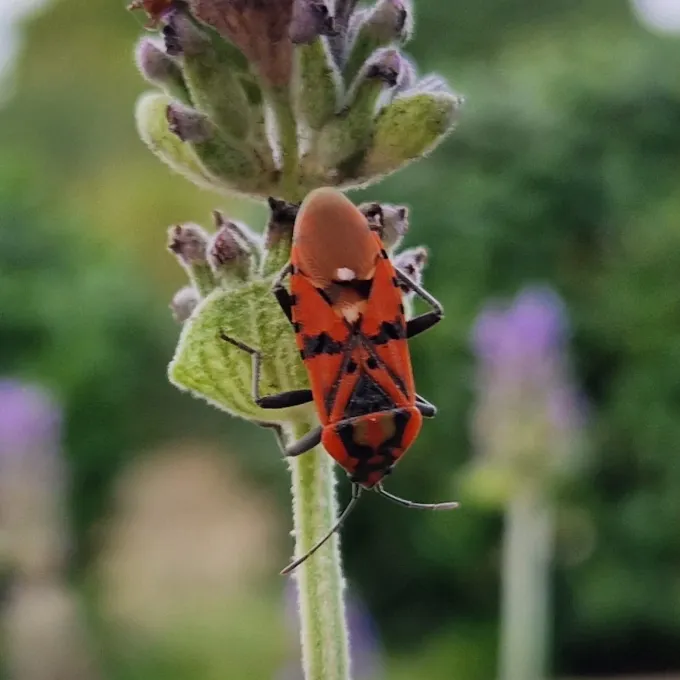
Spilostethus pandurus, commonly known as the red-spotted bug, belongs to the family Lygaeidae within the order Hemiptera. Adults are easily recognized by their striking appearance: a black background on the pronotum and hemelytra featuring distinct red or orange spots and stripes, acting as a warning coloration.
The insect measures approximately 10–14 mm in length and has a flat, oval body shape. Its head is equipped with a robust piercing-sucking proboscis, specialized for penetrating plant tissues and extracting sap.
Nymphs undergo several developmental instars, gradually developing the adult color pattern. While early instars lack fully formed wings, they maintain the same high-contrast red and black warning colors as the adults.
As a thermophilic species, these bugs prefer warm, open habitats where sunlight is abundant. Their metabolic activity and feeding rates are closely linked to ambient temperature fluctuations.
Females lay eggs either in the soil or directly on host plants, ensuring that the emerging nymphs have immediate access to a food source.
What it damages
Spilostethus pandurus is a polyphagous pest, capable of damaging a wide array of crops including cereals, oilseeds, vegetables, as well as various ornamental and wild plants.
It poses a significant threat to sunflowers, potatoes, tomatoes, and various brassica species, as it feeds on the sap from leaves, stems, and developing seeds.
Both adults and nymphs contribute to the damage by congregating on the aerial parts of plants, which weakens the plant's overall physiological health and nutrient uptake.
In cases of high infestation, the pest can cause wilting of vegetative growth, fruit deformation, and a notable decrease in overall crop yield and quality.
Feeding on seed crops is particularly detrimental, as the insects pierce the protective coat, leading to poor germination and reduced seed viability.
When it appears
In temperate climates, the pest is most active during the summer months, with activity commencing in late spring as soon as consistent warm weather patterns are established.
The life cycle involves incomplete metamorphosis: egg, nymph, and adult. Depending on the geographical region and climate, the species can complete one or two generations per year.
The species primarily overwinters as an adult, seeking shelter under plant debris, in the upper layers of soil, or within protected nooks that offer insulation against wind and cold.
Emergence from diapause occurs in early spring once daily average temperatures exceed the biological threshold required for the insect to resume feeding and mating activities.
Population peaks typically occur during the second half of summer, coinciding with the critical growth and maturation phases of many agricultural crops.
Signs of infestation
Visible clusters of vibrant red and black insects on stems and leaves are the most obvious indication of an infestation within a field or garden.
Symptoms of feeding damage include small necrotic punctures that eventually coalesce into larger lesions, leading to yellowing and subsequent tissue necrosis.
During field inspections, one may notice thinning or wilting plant tips, especially during dry spells when the bugs' demand for plant moisture increases.
The presence of nymphs at various developmental stages, particularly within flower heads or on the undersides of leaves, confirms active colonization and breeding.
Delayed development of fruit or irregular growth patterns often occur as a direct consequence of disrupted nutrient flow caused by the insects' intensive feeding.
Control measures
Effective management begins with robust agronomic practices, specifically the timely removal of weeds, which often serve as primary reservoirs and host plants for the bugs.
Deep autumn plowing is a recommended cultural practice to disrupt overwintering sites, effectively reducing the adult population density for the following growing season.
When infestation levels exceed the economic threshold, contact-stomach insecticides registered for use on specific crops should be applied as directed.
Crop rotation and spatial isolation between susceptible host crops are highly recommended to impede the movement and spread of the pest population.
- Regular monitoring of crop health and population density.
- Sanitation measures to clear crop residues post-harvest.
- Integration of biological controls during early-stage or low-density infestations.
Discussion
No discussions yet — be the first.