
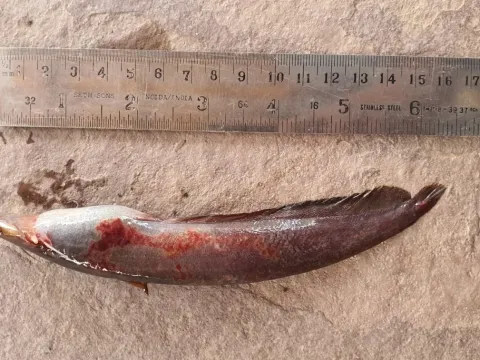
Walking catfish
Saccobranchus fossilis
The walking catfish (Heteropneustes fossilis, formerly Saccobranchus fossilis) is a hardy tropical fish recognized for its distinctive physiological adaptations.
What the section contains
Walking catfish
It possesses air-breathing respiratory organs, specifically long sacs extending from the gill cavity, allowing it to survive in oxygen-poor water and even on land.
The body is elongated and scaleless, typically dark brown or black, which helps it hide in muddy environments and murky pond bottoms.
It features four pairs of long sensory barbels that are essential for navigation and foraging in low-visibility aquatic environments.
The pectoral and dorsal fins contain sharp, venomous spines that provide protection against predators and pose a significant risk to human handling.
As an invasive species, the walking catfish is highly destructive to aquaculture by preying on the fry and eggs of commercially valuable fish.
It aggressively outcompetes native fish species for food and shelter, leading to a significant loss of biodiversity within artificial ponds.
The species is known for destroying irrigation infrastructure and burrowing into the banks of ponds and rice fields, weakening water retention structures.
Due to its high fertility and adaptability, it can quickly dominate a water body, making it difficult to maintain intended stocking densities.
Human safety is compromised during pond maintenance and harvesting due to the venomous stings associated with the fish's fin spines.
The activity of the walking catfish significantly increases during the warmer months when water temperatures range from 20 to 30 degrees Celsius.
The breeding season typically coincides with the onset of monsoon rains, during which the fish displays increased movement and reproductive behavior.
In colder conditions, the fish becomes sluggish and seeks refuge deep within the bottom substrate to survive until warmer weather returns.
High-risk periods for agricultural infestation occur during the summer when the catfish is capable of traversing damp land to invade new water sources.
Effective management requires continuous monitoring of pond water quality and perimeter conditions throughout the primary growing season.
A sudden decline in the survival rate of nursery-reared fingerlings in aquaculture ponds is a primary indicator of walking catfish presence.
The appearance of burrowing holes along pond dikes and banks suggests that the catfish is utilizing the area for shelter and nesting.
Personnel encountering stings or injuries during routine pond cleaning are often the first sign of an established catfish population.
Observation of fish surfacing during the night or early morning in muddy conditions can confirm the presence of this air-breathing predator.
Routine sampling and netting procedures will likely reveal the presence of dark-colored, long-whiskered fish that do not match the stocked species.
The most effective strategy involves complete draining and lime treatment of pond bottoms to eradicate all life stages of the catfish.
Installing high-quality intake screens and mesh barriers on water supply canals prevents the entry of both adults and juveniles into the system.
Targeted harvesting using specialized electrical equipment can help reduce population density in large-scale aquaculture operations.
Biological control, such as promoting native fish predators, can serve as a supplementary method for minimizing catfish populations.
- Total pond drainage and dry-out.
- Lime application to soil beds.
- Intake water filtration systems.
- Regular species composition monitoring.