
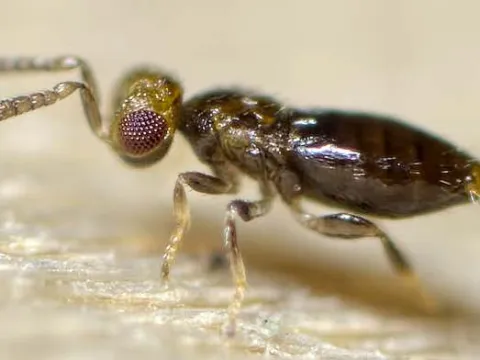
Prospaltella
Prospaltella taeniata
Prospaltella (Prospaltella taeniata) is a microscopic insect belonging to the order Hymenoptera and the family Aphelinidae. The adult is a tiny parasitic wasp with a body length rarely exceeding one millimeter.
What the section contains
Prospaltella
The species is characterized by specific wing venation and coloration typical of coccid parasitoids. Detecting this insect on a plant with the naked eye is extremely difficult due to its miniature size.
The female plays the primary role in the life cycle, actively searching for hosts to oviposit her eggs underneath the protective scales of the host insects.
Males are encountered much less frequently than females and typically have a shorter lifespan, which is a common trait among this family of parasitoid wasps.
Accurate species identification in the field requires laboratory analysis, as morphologically, Prospaltella is quite similar to other related parasitoid species found in similar ecosystems.
The primary targets for the development of Prospaltella larvae are scale insects and soft scales that infest various agricultural crops, including fruit trees and citrus.
Although Prospaltella is often classified as a beneficial biological control agent, it is important to monitor its interaction with host populations within an agroecosystem to maintain ecological balance.
The damage associated with the activity of scales, which are targeted by Prospaltella, includes the suppression of reproductive functions of pests infesting leaves, shoots, and fruits.
In the absence of natural hosts or under disrupted environmental conditions, the presence of the parasitoid can serve as an indicator of high scale insect density in an orchard.
Scale infestations, which require management, cause shoot deformation, premature leaf drop, and overall physiological stress in host plants, significantly reducing yield.
The life cycle of Prospaltella is strictly synchronized with the development cycles of its hosts. Adult activity is observed during periods of intense pest feeding, typically in spring and summer.
The duration of a single generation ranges from a few weeks to a month, allowing the species to produce multiple generations throughout the growing season.
The parasitoid overwinters inside the host body at the larval or pupal stage, ensuring high survival rates during unfavorable environmental conditions.
Mass emergence of adult wasps often coincides with the active growth period of young shoots, when host population density reaches critical levels.
Climatic factors such as air temperature and humidity significantly influence reproduction rates, thereby determining the species' distribution and overall population density.
The primary sign of Prospaltella presence is the appearance of microscopic circular holes on the dorsal shield of the deceased scale insect, through which the adult wasp exits.
When inspecting infested bark or leaves, one may notice dry, discolored scale coverings that easily flake off upon physical contact.
An indirect sign of successful parasitoid activity is a noticeable decline in the growth rates of scale colonies on infested branches throughout the season.
The absence of live scale insects alongside a large number of old, damaged shells indicates that the parasitoid is effectively managing the pest population.
Yellow sticky traps are frequently used to monitor parasitoid activity by capturing adult wasps during their peak flight periods.
Modern integrated pest management (IPM) strategies emphasize the preservation of natural populations of beneficial insects, including Prospaltella.
It is essential to avoid the use of broad-spectrum systemic insecticides during periods of active parasitoid flight to prevent unnecessary population decline.
- Application of selective biological pesticides.
- Timely sanitary pruning of heavily infested plant parts.
- Establishing ecological buffer zones to support beneficial insect populations.
- Monitoring pest density using specialized pheromone or color-based traps.
Agrotechnical practices that improve overall plant vigor significantly reduce the risk of massive scale infestations.
In cases of severe infestation, preference is given to biological control methods, which helps avoid chemical contamination of fruit produce and maintains a healthy agroecosystem.