
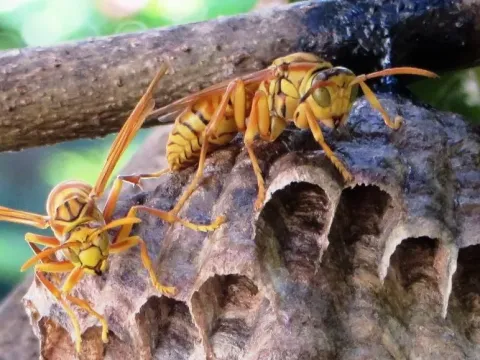
Paper wasp
Polistes hebraeus
The paper wasp (Polistes hebraeus) belongs to the order Hymenoptera and the family Vespidae. They are social insects known for constructing nests made of a paper-like material from chewed wood fibers.
What the section contains
Paper wasp
Adult wasps are typically yellow-brown with distinct black abdominal stripes. They measure between 15–20 mm in length, with queens being slightly larger than the workers.
A key identifying feature is their narrow "wasp waist" and long legs that dangle noticeably during flight. Their nests are characterized by open-faced honeycomb structures attached by a single pedicel.
The life cycle begins in spring when the overwintering queen establishes a new colony. The larvae develop within the cells, cared for by the workers.
By late summer, the colony reaches its peak population size, which coincides with the ripening of many crops, increasing their interaction with agricultural production.
In an agricultural context, Polistes hebraeus causes damage by feeding on the juices of ripe fruits and berries. They pierce the skin of grapes, peaches, plums, and pears to access the sugary pulp.
Damaged fruit loses its market value, as the entry points promote decay, fermentation, and the growth of various fungal pathogens or mold.
While wasps are predatory and can help control some pest caterpillars, their nuisance behavior and destruction of nearly-ripe fruit often outweigh their benefits as natural enemies.
The presence of large nests near harvest sites poses a significant risk to workers, as these wasps can be aggressive when their nests are disturbed during harvest activities.
On large-scale vineyards and orchards, severe infestations can lead to substantial yield losses, particularly during hot and dry seasons when water and sugar sources are scarce.
The most obvious sign of infestation is the discovery of the distinctive paper-like nests, often located under eaves, inside garden structures, or hidden within dense tree canopies.
Visual evidence of damage includes fruit with small, circular perforations surrounded by dark decay or mycelium growth, indicating that wasps have been feeding.
Heightened wasp activity around compost heaps, outdoor bins, or piles of discarded fruit is a clear indicator that a colony is active in the vicinity.
Daytime observation of flight paths—where wasps are consistently moving between food sources and nesting sites—can help locate the exact position of the colony.
Massive gatherings of wasps on ripening grape clusters are a high-alert sign that immediate protective measures are required to save the remaining crop.
To control populations, nests should be removed or destroyed during the early morning or late evening when the wasps are least active and most of the colony is inside.
A highly effective agricultural method involves placing bait traps filled with a mixture of fermented juice, beer, or sugar water, sometimes supplemented with selective insecticides.
During the peak ripening phase, covering high-value crops like grapes or specific fruit trees with fine-mesh protective netting provides a strong physical barrier.
Maintaining orchard hygiene is critical; this includes the immediate removal of fallen fruit and the proper management of organic waste to prevent attracting wasps to the area.
Chemical control should be avoided during the harvest period to ensure produce safety, making mechanical trapping and environmental management the preferred strategies.