
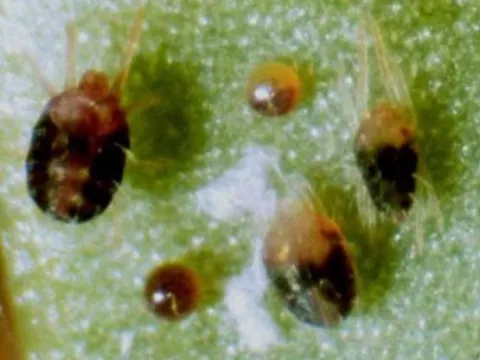
Paratetranychus mite
Paratetranychus
The genus Paratetranychus belongs to the family Tetranychidae, commonly known as spider mites. These are tiny arthropods, often measuring less than 0.5 mm in length.
What the section contains
Paratetranychus mite
Adult individuals exhibit varying colors ranging from pale yellow to deep reddish-brown, often depending on the specific host plant and environmental conditions.
Their bodies are oval-shaped and slightly convex. As members of the Acariformes order, adults possess four pairs of legs, while the early larval stages have only three.
Males are typically smaller than females and have a more tapering posterior end, which serves as a key morphological feature for identification under magnification.
Eggs are spherical and are often deposited on the underside of leaves, protected by fine, characteristic silk webbing produced by the females.
Mites of the Paratetranychus genus are polyphagous, meaning they infest a wide variety of plants, including fruit trees, shrubs, and ornamental species.
Common hosts include apple, pear, citrus trees, and several coniferous varieties such as spruce and juniper, where they can cause significant stress.
Damage is caused by the mites piercing plant cells and extracting sap, which disrupts chlorophyll production and interferes with normal photosynthesis.
Severe infestations lead to premature leaf drop, which weakens the plant, reduces fruit set, and lowers overall resistance to winter conditions.
In nursery settings, heavy mite pressure can stunt seedling growth, leading to significant economic losses and potential plant mortality.
Paratetranychus populations typically become active in the spring as temperatures rise, signaling the end of the winter diapause for overwintering females.
The summer months provide the most favorable conditions for rapid reproduction, especially during hot and dry spells that accelerate the mites' life cycle.
The life cycle from egg to adult can be completed in as little as 7 to 14 days under optimal warm conditions, allowing for multiple overlapping generations.
As autumn approaches and day length decreases, females prepare for winter diapause by seeking shelter in bark crevices or under plant debris.
Population density usually peaks during mid-to-late summer, making this the critical period for monitoring and implementing control measures.
The earliest signs of infestation are tiny, chlorotic stipples on the leaf surface, representing areas where cells have been emptied of contents.
As feeding continues, these spots coalesce, causing the foliage to appear yellowed, bronzed, or stippled, which is highly visible on green leaves.
The presence of fine webbing on the underside of leaves is a diagnostic sign of spider mite activity and serves as a nursery for the developing colony.
Extensive damage results in leaf curling and drying, eventually leading to senescence and detachment from the branch.
Field diagnosis can be confirmed by tapping leaves over a white sheet of paper to observe the presence of tiny, active mites moving across the surface.
Integrated management begins with cultural practices, such as removing weeds and old debris that may serve as winter refuges for the mites.
Maintaining adequate irrigation is crucial, as water-stressed plants are significantly more susceptible to outbreaks of Paratetranychus.
Chemical control should involve the use of specific miticides that target mites while preserving natural predators like predatory mites and lady beetles.
To avoid the development of pesticide resistance, it is essential to rotate products with different modes of action throughout the growing season.
- Introduction of biological control agents such as predatory phytoseiid mites.
- Targeted application of acaricides during the peak larval emergence phase.
- Systematic field monitoring to assess mite density thresholds before spraying.