
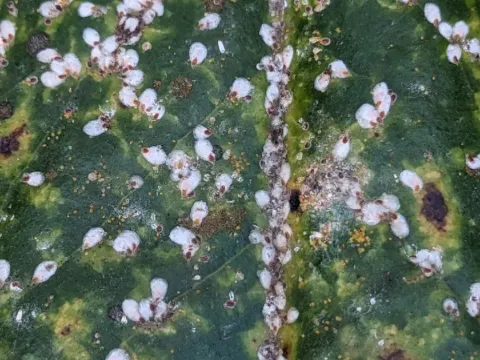
Magnolia scale
Phenacaspis cockerelli
The magnolia scale (Phenacaspis cockerelli) is a member of the order Hemiptera and the family Diaspididae. These insects are distinguished by the hard, armor-like shields they secrete, which in this species appear as elongated, white, or light-colored structures on the plant surface.
What the section contains
Magnolia scale
Adult females are sessile, remaining fixed in one location for their entire lives. They protect themselves and their eggs beneath these waxy covers, which are highly resistant to many environmental factors and standard insecticide sprays.
Adult males are winged and short-lived; their only purpose is to find females for reproduction. Unlike females, they do not feed and are rarely noticed by gardeners due to their small size and brief activity window.
The first-instar nymphs, known as "crawlers," are the only stage capable of active dispersal. They are microscopic and light in color, moving across the plant to find a suitable feeding site before settling down to develop their permanent shield.
Proper identification requires careful examination of the shield shape and the plant host. The white, oyster-shell-like appearance of Phenacaspis cockerelli is a hallmark characteristic that distinguishes it from other armored scale species.
Magnolia scale affects various ornamental plants, most notably magnolias, oleanders, palms, and certain conifers. The damage typically occurs on bark, twigs, and the undersides of leaves where the insects attach to feed.
By inserting their mouthparts into the plant tissue, these insects extract vital phloem sap. This leads to a loss of vigor, stunted growth, yellowing foliage, and potentially the death of individual branches or entire small plants.
A secondary consequence of the feeding is the production of honeydew, a sticky, sugar-rich substance. This discharge provides a growth medium for sooty mold, a fungus that covers leaves and blocks sunlight, interfering with photosynthesis.
Severe infestations weaken the plant's immune system, making it more susceptible to environmental stress, drought, and attacks from other pests or secondary fungal infections.
Over time, the cumulative effect of thousands of insects feeding on the same branches can lead to branch dieback and an overall thinning of the canopy, significantly reducing the aesthetic value of the ornamental tree.
The lifecycle of the magnolia scale is heavily dependent on temperature. Active development typically accelerates during the warm spring and summer months when the metabolism of the insects is at its peak.
The crawler stage usually emerges in late spring to early summer. This is the period when population expansion is most rapid, as new generations settle on fresh growth to establish their own feeding colonies.
In greenhouse or conservatory environments, magnolia scale can complete multiple generations throughout the year due to the consistent climate, making it a persistent problem for indoor horticulture.
As temperatures drop in autumn, the scale insects prepare for winter, typically by slowing their metabolic activities. Most species overwinter as partially developed nymphs or adults tucked away in bark crevices.
Monitoring should be most intensive from late spring through mid-summer. Detecting the crawler stage early is crucial for effective control, as once the scale builds its protective cover, it becomes significantly harder to eradicate.
The most obvious sign of an infestation is the presence of white, elongated scale coverings on the stems and leaves. These often look like small, white calcareous spots or crusts on the bark.
Sticky residue on the leaves or the ground beneath the plant is a classic indicator of scale activity. This honeydew often turns black as sooty mold colonizes the sugary layer, creating a distinctively dirty appearance.
Yellowing, drooping, or premature leaf drop are common symptoms of a stressed plant. If these occur without a clear pathogen cause, the undersides of leaves and twigs should be inspected for the scale's characteristic shields.
Increased ant activity around a plant is often a sign of scale presence, as ants are attracted to the honeydew and will often protect the scale colonies from natural predators.
A physical check can confirm the presence of the pest: if you scrape a "spot" with your fingernail and find a soft, moist body underneath, it is confirmation of a living scale insect rather than just a fungal growth or debris.
Integrated Pest Management (IPM) is essential for controlling magnolia scale. Start by pruning and removing heavily infested branches to reduce the total population of the insects in the immediate vicinity.
Systemic insecticides, particularly those containing imidacloprid or acetamiprid, are highly effective. When applied as a soil drench or foliage spray, the plant absorbs the chemical, making the sap toxic to the feeding scales.
Contact insecticides should be applied specifically during the crawler emergence phase. Timing is critical: spray applications must be repeated according to label instructions to catch the entire population before they form their protective shields.
Mechanical removal—using a soft brush dipped in a soap solution—can be effective for cleaning smaller, prized ornamentals. However, this method is labor-intensive and mainly suitable for localized control.
- Apply systemic insecticides
- Prune infested twigs
- Monitor for crawler stage
- Use horticultural oils in spring
- Increase plant health through proper watering