
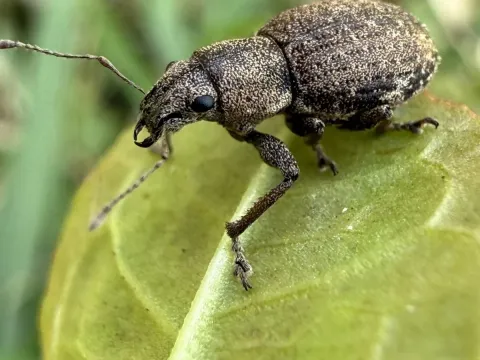
Fuller rose beetle
Pantomorus cervinus
The Fuller rose beetle (Pantomorus cervinus) belongs to the order Coleoptera and the family Curculionidae. The adult beetle is approximately 8–10 mm long and has a grayish-brown coloration.
What the section contains
Fuller rose beetle
The insect's body is covered with dense scales, and a distinctive feature is its elongated snout and the inability to fly, as the wing covers (elytra) are fused together in this species.
The larvae are legless, cream-white in color with a brown head capsule, and reach about 12 mm in length. They reside primarily in the soil, feeding on plant roots.
The life cycle includes the egg, larval stage, pupal stage, and adult. Reproduction occurs parthenogenetically, as males are extremely rare or completely absent in the population.
Eggs are laid by females in hidden locations such as under tree bark, in stem crevices, or inside rolled leaves, making them difficult to detect.
This pest is a polyphage and affects a wide range of agricultural and ornamental crops, including citrus, grapes, potatoes, strawberries, and various decorative flowers.
Adults cause the primary damage to the aerial parts of plants by chewing the leaf edges, resulting in a characteristic serrated or jagged edge, often resembling a saw blade.
Larvae developing in the root zone cause the most serious damage by chewing through small roots and damaging the bark of larger roots, which severely impairs the plant's health.
Heavy infestation of the root system by larvae leads to impaired nutrient uptake, wilting, yellowing of foliage, and eventually the potential death of the plant.
Economic losses arise from both direct yield reduction and the loss of marketability of fruits and nursery stock, which can be damaged during transport.
Adult activity is observed primarily during warmer months when temperature conditions facilitate their migration up stems for feeding.
Larvae are present in the soil throughout the year, but their most intensive feeding and growth occur during the active plant growing seasons when roots are rich in nutrients.
Pupation usually occurs in the soil during spring or early summer, after which adults emerge from the soil, ready for mating and egg-laying.
Depending on climatic conditions, the pest generation can be annual or extended over a longer period, making it difficult to predict peak infestation times.
Monitoring for the beetle is most effective during early morning or evening hours, when adults climb plants to engage in supplementary feeding.
The primary external sign is "ragged" leaf edges, where the leaf margins become irregular and notched due to adult beetle feeding.
Sudden wilting of plants without obvious external causes in the foliage may indicate severe damage to the root system by the larvae.
Upon inspecting the root ball or soil around the plant, one may discover cream-colored larvae that move actively when removed from the substrate.
The presence of egg masses in plant folds or under bark scales serves as direct confirmation of the pest population on the site.
The presence of adults on the underside of leaves during the day, particularly in the lower canopy, confirms an active stage of infestation.
Chemical control includes the application of systemic insecticides, which are effective in killing adults as they feed on treated plant tissues.
An important biological method is the use of entomopathogenic nematodes, which are applied to the soil to destroy larvae in their natural habitat.
Agronomic practices include deep tilling of the soil around trees and shrubs during the pupation period to disrupt the soil cells.
Applying sticky bands to tree trunks prevents the flightless adult beetles from migrating into the canopy to feed and lay eggs.
Regular sanitation of the site by removing plant debris and weeds eliminates shelters and egg-laying sites, reducing the overall population density.