
Garden fleahopper
Halticus citri
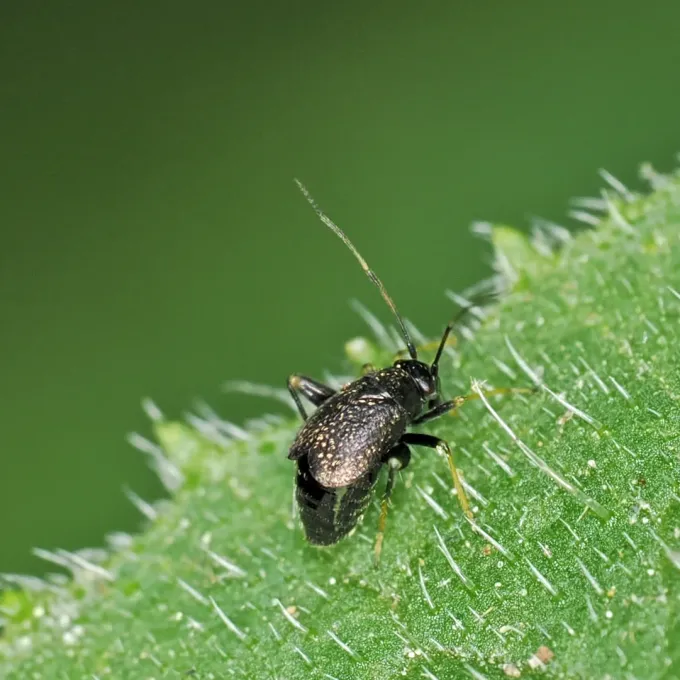
Description
How to identify
The garden fleahopper (Halticus citri) is a small insect belonging to the Miridae family, often mistaken for a flea beetle due to its jumpy behavior when disturbed.
Adult insects have black or dark brown bodies that measure approximately 2–3 millimeters in length, often featuring tiny white spots on their forewings that give them a speckled appearance.
Nymphs resemble smaller versions of the adults but lack wings and possess a lighter, greenish-yellow hue, which gradually transitions to darker tones as they mature.
The insect possesses enlarged hind femora, which are specialized for leaping, making them highly elusive and difficult to manage during field inspections.
The life cycle encompasses eggs, five nymphal instars, and the adult stage, with multiple generations possible during a single season in warm climates.
What it damages
This pest is a generalist feeder that affects a wide range of agricultural crops, particularly members of the Solanaceae, Fabaceae, and Cucurbitaceae families.
Common host plants include tomatoes, cucumbers, beans, soybeans, and various ornamental plants, as well as common weeds that act as reservoir hosts.
The insect feeds by piercing plant tissues with its mouthparts and sucking out sap, which causes localized cell death and disrupts essential metabolic processes.
Heavy infestations can lead to significant yield losses, especially during hot and dry spells when the stress on host plants is already elevated.
In addition to direct feeding damage, the garden fleahopper may facilitate the transmission of various plant viruses and phytoplasmas between susceptible crops.
Signs of infestation
Early signs of infestation manifest as numerous minute, light-colored stippling or chlorotic spots on the leaf surface at the sites of feeding punctures.
As the feeding continues, leaves may develop a mottled or webbed appearance, turn yellow, curl, and drop prematurely, which severely reduces photosynthetic capacity.
Clusters of nymphs and adults are often found on the underside of leaves, accompanied by tiny black fecal spots that can attract sooty mold growth.
Heavily infested plants exhibit stunted growth, delayed flowering, and reduced fruit quality, which directly impacts the profitability of the harvest.
Detection is often difficult because the adults are extremely sensitive to movement and will jump away or hide beneath foliage as soon as they are approached.
Control measures
The most effective management strategy involves the consistent removal of weeds in and around fields to eliminate overwintering sites for the pest population.
Crop rotation and maintaining spatial distance between new plantings and old, infested sites help reduce the migration of the garden fleahopper.
In greenhouses and high tunnels, yellow sticky traps can be effectively utilized for monitoring population levels and capturing adult insects before they reproduce.
Chemical control should be implemented based on scouting data, with systemic insecticides often providing better results than contact-only sprays.
- Weed management to remove hosts.
- Crop rotation and spatial isolation.
- Use of yellow sticky traps for monitoring.
- Application of targeted systemic insecticides.
Discussion
No discussions yet — be the first.