
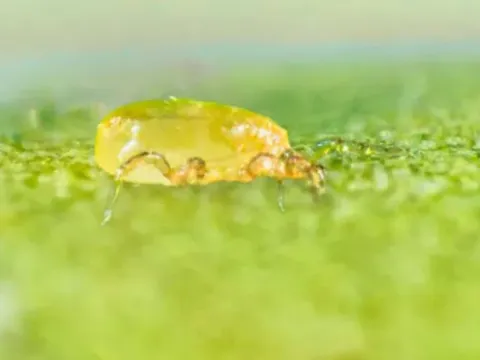
Neoseiulus barkeri
Neoseiulus barkeri
Neoseiulus barkeri is a species of predatory mite belonging to the Phytoseiidae family and the Mesostigmata order, widely used as an effective biological control agent.
What the section contains
Neoseiulus barkeri
These mites are very small, measuring approximately 0.4–0.5 mm in length, and are usually pale beige or brownish depending on their food source.
Their body shape is typically teardrop-like, and they are highly mobile, moving rapidly across leaf surfaces to search for potential prey items.
While they are beneficial, correct identification is essential, as they are often confused with harmful spider mites by those unfamiliar with entomology.
They undergo a complete life cycle, including egg, larva, protonymph, deutonymph, and adult stages, which is adapted to high-humidity greenhouse environments.
As a predatory species, Neoseiulus barkeri does not damage plants, as it does not consume plant sap or tissues for its sustenance.
It is specifically valued for its ability to hunt and consume various pests, primarily the larvae of the Western flower thrips (Frankliniella occidentalis).
By controlling pest populations early in the cycle, the mite prevents significant damage to plant foliage, buds, and delicate flowers.
They can also feed on alternative food sources such as plant pollen, which allows them to sustain their populations even when pest density is low.
The presence of these mites contributes to integrated pest management (IPM) strategies, significantly reducing the reliance on synthetic chemical insecticides.
The activity of Neoseiulus barkeri is heavily dependent on temperature and moisture conditions within the greenhouse or field habitat.
They thrive best in temperatures ranging from 20°C to 30°C and require relative humidity levels above 60% to remain fully active and fertile.
In temperate climates or heated greenhouses, they can remain active throughout the year, providing continuous protection for crops like cucumbers and peppers.
If temperatures drop below 10°C, their metabolic activity slows down significantly, reducing their effectiveness as a predator against thrips.
Strategic release schedules are recommended to ensure a high population of predators is present before the peak season of greenhouse pests occurs.
Since the mite is beneficial, the primary sign of its success is the absence of pest symptoms, such as silver stippling or distorted leaves caused by thrips.
Monitoring the underside of leaves using a magnifying glass or microscope will reveal the presence of the predatory mites moving actively along the leaf veins.
A lack of rapid increase in pest population density on yellow sticky traps is a strong indicator of successful predation by Neoseiulus barkeri colonies.
Plants protected by these mites generally show healthier development, with undisturbed terminal buds and flowering parts that remain free from pest-induced scarring.
Observation of low thrips counts in floral parts, combined with the presence of small, fast-moving mites, confirms that the predator is performing its function.
Managing the population of Neoseiulus barkeri involves creating optimal conditions for their survival and avoiding practices that might threaten them.
- Avoiding the use of broad-spectrum pesticides that are toxic to beneficial predatory mites.
- Maintaining greenhouse humidity levels within the recommended range for optimal mite reproduction.
- Introducing predator mites as a preventative measure before pest infestations reach critical levels.
- Using compatible biological agents if other pest management measures are required.
- Monitoring the crop frequently to evaluate the balance between pest populations and predatory mite density.