
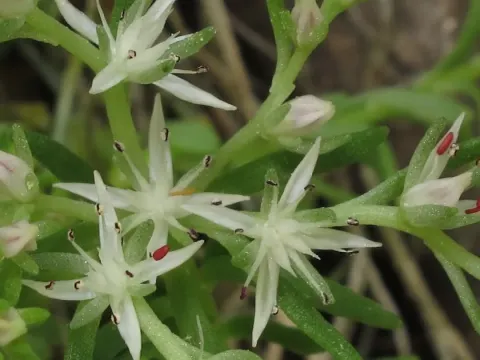
Nevius stonecrop
Sedum nevii
Sedum nevii, commonly known as Nevius stonecrop, belongs to the family Crassulaceae. It is a perennial, low-growing succulent plant native to rocky habitats, prized for its ornamental qualities in rock gardens.
What the section contains
Nevius stonecrop
Contrary to any misclassification as a pest, this plant does not attack crops, nor does it feed on plant tissues. It is a strictly botanical species that lives independently of agricultural production systems.
The biology of the plant is characterized by small, fleshy leaves arranged in rosettes and star-shaped white flowers. It thrives in well-drained soils and is highly resistant to drought due to its water-storing capabilities.
The life cycle of Sedum nevii involves active spring growth, flowering in mid-summer, and a dormant phase during the winter months. It spreads slowly through stolons, allowing it to form dense mats over time.
In agricultural settings, it does not pose any phytosanitary risk. It is not listed as a quarantine pest, nor is it known to transmit plant diseases that could impact commercial agriculture.
As Nevius stonecrop is not a pest, there are no control measures designed for its management. It does not cause damage to crops, fruit trees, or vegetable patches.
If you wish to manage its growth in a decorative setting, simple hand-pulling or mechanical cultivation is sufficient. Because its root system is shallow, it can be easily removed without disturbing the surrounding soil profile.
Using physical barriers or garden borders is an effective way to keep the plant within a designated area. This is a standard practice for maintaining the aesthetics of any ornamental landscape.
Chemical control is unnecessary and discouraged, as it may cause damage to the surrounding beneficial vegetation and the soil micro-environment. Mechanical control remains the most environmentally friendly option.
For gardeners concerned about unwanted spread, light pruning after the flowering season can prevent seed dispersal, although the plant typically spreads more through vegetative division in garden conditions.