
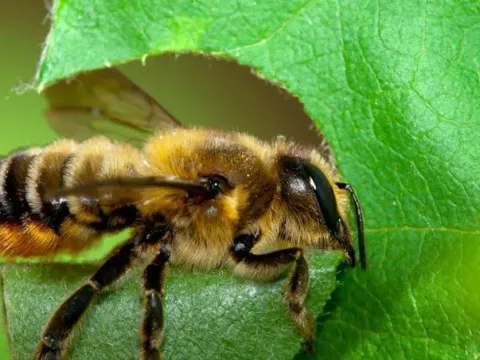
Alfalfa leafcutting bee
Megachile pacifica
The alfalfa leafcutting bee (Megachile pacifica, formerly Megachile rotundata) is a solitary insect belonging to the Megachilidae family. It is distinct from honeybees due to its stouter body and dense pubescence.
What the section contains
Alfalfa leafcutting bee
Adult bees typically measure 8–10 mm in length. A key morphological feature is the scopa, a specialized brush of hairs on the underside of the abdomen used for carrying pollen and nesting material.
The lifecycle encompasses egg, five larval instars, prepupa, and pupa stages. Depending on the climatic region, it usually completes one generation per year, although warmer conditions may trigger a second cycle.
Unlike social bees, this species is solitary. Each female constructs individual nesting cells, typically utilizing existing cavities like hollow stems, wood borings, or artificial nesting blocks.
For each cell, the female cuts and gathers circular fragments of leaves. These pieces are rolled to form the structural lining of the nest, which serves as a protective chamber for the developing larvae.
The bee primarily targets leguminous crops, including alfalfa, clover, and sainfoin. In horticultural settings, it is known to affect roses, lilacs, and various deciduous trees.
The damage is strictly mechanical, characterized by the removal of circular or oval segments from leaf margins. While these holes are distinctive, they rarely threaten the survival of mature, healthy plants.
Economic damage occurs only when high population densities lead to severe defoliation, which can stress young seedlings or decrease the photosynthetic efficiency of high-value nursery plants.
It is important to note that the alfalfa leafcutting bee is a highly efficient pollinator. In many agricultural systems, its role as a pollinator is considered far more valuable than the minor leaf damage it inflicts.
The severity of the impact is usually cosmetic, and in professional alfalfa seed production, these bees are often intentionally managed and fostered rather than controlled.
The hallmark of leafcutting bee activity is the presence of clean-cut, smooth-edged holes along the edges of leaves. These look as if they have been punched out by a precise tool.
Nesting sites often appear in hollow stalks, crevices in fences, or deadwood. Checking for these small tubular structures can confirm the presence of a local population of the bee.
Observing the bees during sunny hours reveals their high-speed activity. They move rapidly over foliage, using their mandibles to quickly scissor out sections of leaf tissue.
Unlike feeding pests like caterpillars or beetles, leafcutting bees do not leave droppings (frass), webbing, or necrotic lesions on the remaining leaf tissue.
Damage is typically most evident in the mid-summer months when bees are actively constructing nests to provision their offspring for the following season.
Chemical control is generally discouraged because the species is a valuable pollinator. Broad-spectrum insecticides will kill the bees, often leading to a loss in crop yield due to poor pollination.
Physical exclusion is the most effective management strategy. Using fine-mesh netting over young or valuable plants during the nesting season effectively prevents the bees from reaching the leaves.
For home gardens, applying natural repellents like garlic or wormwood extracts can deter bees from settling on specific ornamental plants, encouraging them to seek material elsewhere.
Sealing cavities in garden structures, such as exposed wood ends or hollow pipes, can reduce the available nesting sites and discourage local bees from concentrating in a specific area.
Integrated Pest Management (IPM) guidelines suggest that unless the damage is causing visible decline to plant vigor, the presence of the bees should be accepted as a standard agricultural reality.