
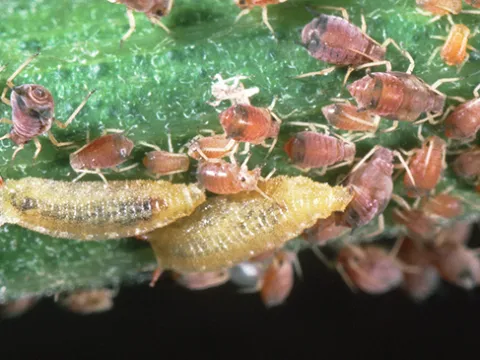
Leucopis punctipennis
Leucopis punctipennis
Leucopis punctipennis is a species of fly belonging to the family Chamaemyiidae (silver flies) within the order Diptera. The adult fly is typically small, ranging from 2 to 3 mm in length, and is characterized by a dusty gray or silvery appearance due to fine hairs covering its body.
What the section contains
Leucopis punctipennis
A distinctive feature of this species is the presence of noticeable dark spots on its wings, which is reflected in its specific name. The head is mobile, featuring well-developed compound eyes, and the mouthparts are adapted for feeding on liquid food, primarily plant nectar and aphid secretions.
The larvae of this species possess a maggot-like, legless body typical of the Chamaemyiidae family. They lead a cryptic lifestyle, often concentrating within colonies of aphids, which makes them difficult to spot during standard field inspections without close examination.
The insect undergoes a complete metamorphosis, including egg, larval, pupal, and adult stages. Its life cycle is closely linked to the presence of aphid populations on crops, as the larvae act as specialized predators that regulate aphid numbers.
It is important to note that many species within the genus Leucopis are recognized as beneficial entomophages. While they are sometimes classified as pests due to their association with damaged plants, their primary role in many agroecosystems is that of a biological regulator.
The primary concern regarding Leucopis punctipennis relates to its association with aphid-infested crops. The fly itself does not cause direct tissue damage to the plant, but its presence is a clear indicator that the crop is suffering from a significant aphid infestation.
Larvae actively feed on aphids by piercing their bodies and consuming their fluids. While this provides a biological service by reducing aphid numbers, high concentrations of larvae and their waste products, combined with the presence of aphids, can facilitate the spread of secondary fungal pathogens.
In cases of severe aphid outbreaks, crops may suffer from leaf curling, stunted growth, and decreased yield due to sap extraction and the injection of toxins by aphids. The presence of the fly does not usually mitigate these damages enough to prevent yield loss in extreme scenarios.
Economic damage becomes significant when the aphid population exceeds the economic injury level. In such conditions, the predatory activity of the larvae is often insufficient to suppress the pest population, necessitating manual or chemical intervention to save the crop.
The density of Leucopis punctipennis serves as a diagnostic sign for agronomists regarding the overall phytosanitary status of the field. A high population of these flies suggests that the agroecosystem is currently under stress from intense aphid activity.
Adult activity typically begins in the spring, once air temperatures stabilize at optimal levels, usually occurring between April and May. The flies emerge to search for host plants already infested with aphid colonies to lay their eggs.
Throughout the summer, the species can complete several generations, depending heavily on the availability of aphid populations. If aphid density remains high throughout the season, the fly population will continue to expand accordingly.
As autumn approaches, the insects prepare for diapause. They complete their development and overwinter as puparia in the top layer of the soil or among plant debris, which provides protection against harsh winter temperatures.
Temperature fluctuations significantly influence the speed of the metamorphosis. Warmer conditions shorten the development cycles, while cooler, wetter weather patterns may lead to periods of low activity for adult flies.
Field monitoring is performed using sticky traps or visual counting methods on sample plots. This data allows agronomists to determine the population dynamics throughout the season and plan effective crop care interventions.
The primary sign of infestation is the discovery of aphids, specifically those showing signs of being preyed upon. This often appears as patchy areas within a colony where aphids are dead, immobile, or show collapsed body structures.
Dark brown puparia can be found attached to the surface of leaves, stems, or near the base of the plant. They are often hidden in the axils of leaves, requiring a thorough inspection to be detected during routine monitoring.
Plants heavily infested by aphids, where Leucopis punctipennis is also present, often exhibit leaf deformation. Additionally, one might observe a black sooty mold growth on the leaves, which develops on the honeydew secreted by the aphids.
During sweeping samples, the adults can be distinguished from other flies by their distinct metallic silver coloration and the characteristic dark spots on the wings. This visual identification is crucial for distinguishing them from other small dipterans.
The unevenness of aphid colony distribution across a field is an important indicator. Where the fly population is active, aphid colonies tend to decline rapidly, serving as a biological marker for the presence of the predator.
Management of this species should be part of an Integrated Pest Management (IPM) program. Controlling weeds is the most critical first step, as they serve as reservoirs for aphids, creating favorable conditions for the fly's proliferation.
Chemical control should only be applied when the economic injury threshold is reached. If the pest density is below this limit, it is advisable to avoid insecticide use to preserve the natural predatory population of the flies.
To support beneficial insects, growers should select selective insecticides that minimize harm to natural predators. This approach helps maintain the natural balance in the field and reduces the need for repeated chemical interventions.
Adherence to crop rotation and optimized planting dates ensures that plants reach a stage of development where they are more resistant to aphid attacks. A healthy, vigorous plant recovers significantly faster from stress compared to a neglected one.
Continuous monitoring using digital scouting tools and professional field assessment allows for timely decision-making. Acting promptly based on accurate population data minimizes crop loss and optimizes the use of agricultural resources.