
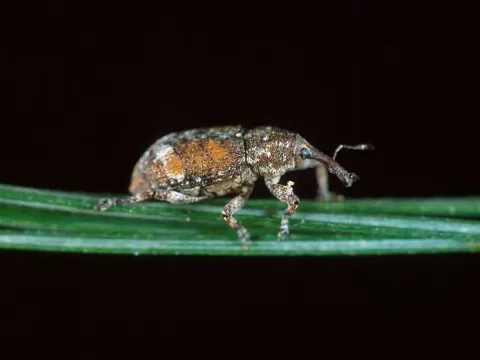
Sitka spruce weevil
Pissodes sitchensis
The Sitka spruce weevil (Pissodes sitchensis) is a member of the Curculionidae family within the order Coleoptera. This insect is a specialist pest that targets coniferous trees, particularly spruce species, across its native range.
What the section contains
Sitka spruce weevil
Adult weevils measure approximately 5 to 8 millimeters in length. Their bodies are typically reddish-brown to black, featuring subtle patterns of light-colored scales on the elytra, which provide excellent camouflage against the bark of host trees.
The larvae are legless, C-shaped grubs with creamy white bodies and distinct brownish head capsules. They spend their entire developmental cycle beneath the bark, feeding on the inner layers of the tree.
Before pupation, larvae construct small chambers or cells within the wood. These chambers are often covered with a cap of shredded wood fibers, a characteristic mark often referred to as "chip cocoons."
Due to their cryptic lifestyle, adult weevils are often hard to spot, and larval damage remains hidden until tree health visibly declines, making early detection a significant challenge for forest managers.
This pest primary affects spruce trees (Picea species), with the Sitka spruce being a highly susceptible host. Damage is most devastating in young stands, nursery settings, and reforestation projects where the trees are still developing their terminal leaders.
Larvae consume the cambium layer as they tunnel, which effectively girdles the leader shoot. This disruption of nutrient and water flow causes the terminal growth to wither, die, and eventually collapse.
The primary consequence of this feeding is the loss of the tree's terminal leader, leading to stunted growth, multi-leader formation, and significant defects in the trunk, which drastically reduces the timber's quality.
Adult weevils also cause minor damage by feeding on buds and new needles, which further weakens the tree. Repeated attacks over several years can leave young trees stunted and aesthetically deformed.
In high-density populations, the Sitka spruce weevil can cause severe economic losses by damaging thousands of trees in a single forest area, potentially requiring replanting or remedial pruning strategies.
Adult activity initiates in early spring as temperatures rise, signaling the beginning of the migration and mating phase. Weevils actively search for host trees to begin their reproductive cycle.
Egg-laying (oviposition) occurs throughout the spring and early summer. The female uses her rostrum to drill small punctures into the bark of the terminal leader, where she deposits her eggs.
The larval stage is the most destructive period, spanning the summer months. During this time, the larvae grow rapidly and expand their galleries, which can eventually encircle the entire shoot.
Pupation typically concludes by late summer or early autumn. New adults emerge from their chip cocoons, feeding for a short period to build energy reserves before preparing for overwintering.
Overwintering occurs in the forest floor litter or protected bark crevices at the base of the trees. The weevils are well-adapted to cold climates and rely on these sheltered locations to survive freezing temperatures.
Early warning signs of an infestation include the appearance of resin droplets (pitch) on the terminal shoots. These droplets form where the female has made punctures in the bark for feeding or egg-laying.
The most iconic symptom is the drooping of the terminal leader, which often curls into a shape resembling a "shepherd's crook." As the shoot dies, the foliage turns from green to yellow and finally brown.
Removal of the bark on affected shoots reveals complex, winding larval galleries packed with brown frass. These galleries are clear indicators that the tree is currently supporting a larval population.
Small, circular exit holes indicate that adult weevils have successfully matured and left the host tree. Their presence confirms that the infestation has reached its completion stage for that season.
- Dead or drooping terminal leaders.
- Resin bleeding on the bark of young shoots.
- Accumulation of fine wood dust (frass) near the base of the tree.
- Presence of chip cocoons beneath the surface of the bark.
Sanitation is a primary management tool. Promptly removing and destroying infested leaders or entire trees before the new generation of weevils emerges is essential to keep local populations in check.
Pheromone traps are used for monitoring population dynamics. These tools provide foresters with critical data on when to time potential insecticide applications or other cultural interventions.
Insecticide treatments may be applied during the early spring to target adults before they lay eggs. However, these applications must be carefully timed and conducted within regulatory guidelines to protect the environment.
Encouraging natural predators, such as parasitic wasps and predatory beetles, can help regulate weevil populations. Maintaining a healthy, diverse forest ecosystem is key to long-term sustainable management.
Silvicultural strategies, such as selecting resistant spruce genotypes or planting mixed-species stands, are among the most effective long-term methods for reducing the impact of the Sitka spruce weevil.