
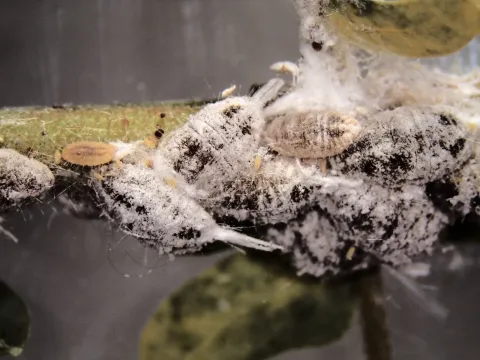
Striped mealybug
Ferrisia virgata
The striped mealybug is a significant insect pest belonging to the family Pseudococcidae. Adult females are approximately 3–4 mm long, oval-shaped, and characterized by a thin waxy covering that reveals two distinct dark longitudinal stripes on the dorsal side of the body.
What the section contains
Striped mealybug
A distinctive feature of *Ferrisia virgata* is the presence of long, thin, waxy filaments extending from the body, and exceptionally long caudal filaments. These filaments make the pest easy to distinguish from other common species of mealybugs.
The first-instar nymphs, known as crawlers, are mobile and have a yellowish to pinkish appearance. They are responsible for the dispersal of the pest within the plant canopy and to adjacent host plants.
The insect prefers protected areas such as leaf axils, the undersides of leaves, and crevices in bark or stems. Their waxy secretion serves as a protective barrier against many environmental stressors and chemical pesticides.
Under favorable greenhouse conditions with temperatures between 25°C and 30°C, the lifecycle is completed rapidly. Reproduction is often parthenogenetic, allowing a single female to establish a large colony in a short period.
The striped mealybug is a highly polyphagous pest with a vast host range, including citrus, cocoa, coffee, cotton, and various ornamental plants. It infests both greenhouse crops and field-grown plants in tropical and subtropical regions.
The pest causes damage by inserting its stylets into plant tissues to feed on phloem sap. This feeding process drains the plant of vital nutrients, resulting in stunted growth, leaf chlorosis, and general decline.
As the insects feed, they excrete large amounts of honeydew. This sticky substance coats the leaves and serves as a medium for the development of sooty mold, which blocks sunlight and hinders photosynthesis.
In addition to direct damage, *Ferrisia virgata* acts as a vector for various plant viruses. This makes them particularly dangerous in nurseries and production farms where virus transmission can lead to total crop loss.
Heavy infestations can lead to the deformation of new shoots and premature fruit drop. For ornamental plants, the aesthetic damage caused by the white waxy debris and sooty mold makes them unmarketable.
The most visible sign of an infestation is the presence of white, cotton-like masses on the stems, leaf axils, or undersides of leaves. These masses are clusters of waxy secretions covering the adult females and their egg sacs.
Sticky residue or honeydew on the foliage is a primary indicator. If you observe shiny, sticky leaves, it is highly likely that a colony of sap-sucking insects is present nearby.
Plants affected by the mealybug often show signs of wilt, yellowing, and leaf curling. Even with regular watering, the plant may appear dry due to the compromised vascular system from constant sap extraction.
In some cases, especially in containerized plants, the mealybug may colonize the root system. If a plant shows unexplained stress, leaf drop, and stunted growth, checking the roots for white waxy deposits is recommended.
An increased presence of ants on the plant is a classic sign. Ants are attracted to the sugary honeydew excreted by the mealybugs and will actively protect them from natural predators, making control more difficult.
Effective management begins with stringent phytosanitary practices. Inspect all new plant material upon arrival and keep new additions under quarantine to prevent the introduction of the pest into the main area.
Mechanical removal is viable for small infestations. Wiping affected areas with a cotton swab soaked in isopropyl alcohol or horticultural soap solution can effectively kill the insects on contact.
Biological control is highly recommended in greenhouses. Predators such as the ladybird beetle *Cryptolaemus montrouzieri* or various parasitoid wasps have proven highly successful in reducing mealybug populations.
Chemical control requires the use of systemic insecticides, particularly neonicotinoids. Because the waxy coating repels water-based sprays, systemic chemicals are more effective as they are ingested by the pest during feeding.
When applying sprays, always include a surfactant (spreader-sticker) to improve coverage. Repeat treatments are essential, spaced 7–10 days apart, to manage new generations of crawlers as they emerge from the protective egg sacs.