
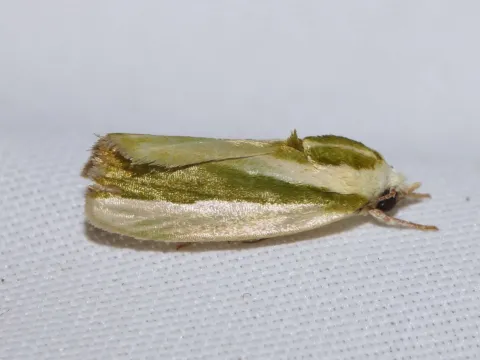
Spotted bollworm
Earias fabia
The spotted bollworm, scientifically known as Earias fabia, belongs to the order Lepidoptera and the family Nolidae. The adult moth has a wingspan of approximately 20–25 mm, making it a relatively small but highly destructive species.
What the section contains
Spotted bollworm
The forewings are distinctively colored, featuring a creamy-white base with a prominent greenish or olive-colored band running centrally. This coloration provides excellent camouflage against plant parts.
Larvae, or caterpillars, pass through five instars during their development. They reach a length of 15–20 mm and are characterized by a brownish-grey body with longitudinal stripes and notable orange spots.
Pupation occurs within sturdy, boat-shaped, greyish-brown cocoons. These are often found attached to dry leaf debris, stems, or in the top layer of soil near the base of host plants.
The life cycle encompasses a complete metamorphosis from egg to adult. The speed of these stages is heavily influenced by ambient temperature and relative humidity, dictating the number of generations per year.
This pest primarily targets plants within the Malvaceae family, with cotton (Gossypium) being the most economically significant host for commercial cultivation.
Other host plants include okra (Abelmoschus esculentus), hibiscus, and various wild mallow species, which can serve as alternate hosts and bridges for the pest between growing seasons.
The primary damage is caused by the larvae feeding on the reproductive parts of the plant, specifically flower buds (squares), blossoms, and developing bolls.
Once a larva bores into a boll, it consumes the internal tissues and seeds, causing the boll to stop growing, deform, or fall prematurely. This significantly lowers the quality and yield of the fiber.
Secondary infections, including various fungi and bacteria, often follow the initial damage caused by the larvae, leading to internal rotting and further degradation of the crop value.
Adult moths are nocturnal in nature, remaining hidden in the dense foliage of the host plants during the daylight hours to avoid predators and extreme heat.
Egg-laying activity is most intense during the flowering and boll formation stages of the crop. Females lay eggs individually or in small clusters, primarily on the bracts and under the leaves.
Developmental rates are rapid in warmer climates, where a generation can complete its cycle in as little as three to four weeks, allowing for rapid population explosions.
Overwintering usually takes place in the pupal stage. Cocoons are commonly found in plant debris, soil crevices, or under tree bark near fields, providing protection from harsh winter conditions.
Agronomic monitoring using pheromone traps is essential to detect the arrival of adult moths early in the season, allowing for timely intervention before high-density infestation occurs.
The most recognizable field sign of infestation is the premature shedding of flower buds, commonly referred to as "square shedding," which leaves the plant stunted.
- Entry holes bored into buds and bolls by the feeding larvae.
- Accumulation of larval frass (excrement) around the entrance holes on the bolls.
- Deformed or asymmetrical bolls that fail to open correctly during harvest.
- Stained or rotted lint inside bolls, caused by larval feeding and subsequent pathogen entry.
- Presence of live larvae or empty pupal cocoons on the plant structure during physical inspection.
Cultural control is the first line of defense. Deep plowing of fields after harvest helps to bury and destroy overwintering pupae, significantly reducing the initial population for the following year.
Effective weed management is crucial. Removing alternative Malvaceae hosts from field borders and surrounding areas denies the pest its survival food source during the off-season.
Biological control methods involve the release of specific egg parasitoids like Trichogramma species, which can suppress the bollworm population effectively without the use of chemicals.
Chemical intervention should be based on economic threshold levels established by systematic field monitoring to minimize environmental impact and unnecessary costs.
Integrated Pest Management (IPM) strategies require the rotation of insecticides with different modes of action to prevent the development of physiological resistance within the bollworm population.