
American house dust mite
Dermatophagoides farinae
Description
How to identify
The American house dust mite (Dermatophagoides farinae) belongs to the order Sarcoptiformes and the family Pyroglyphidae. In agricultural settings, it is recognized as a significant pest affecting stored agricultural commodities.
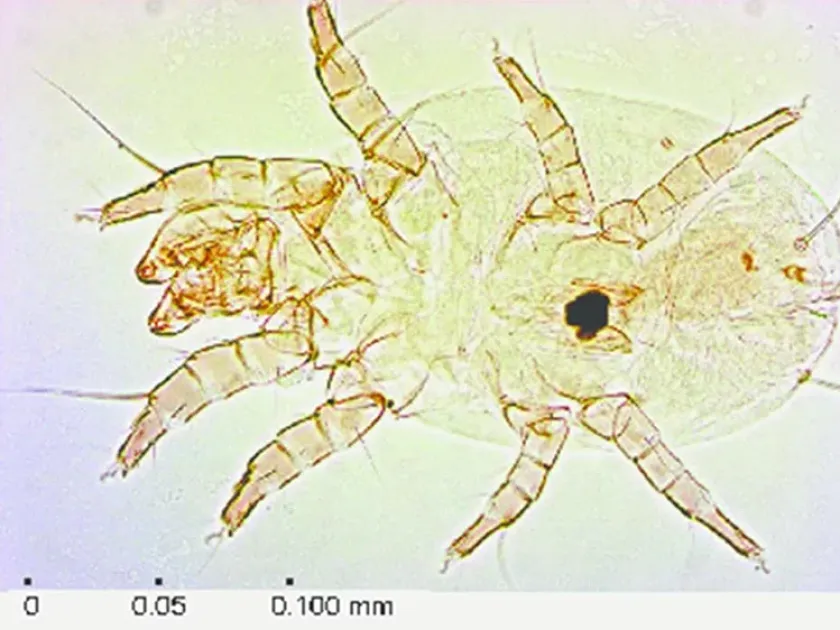
Adult mites are microscopic, measuring roughly 0.3–0.4 mm in length. Their flat, oval bodies are pale white, making them invisible to the naked eye when present in bulk grain or stored products.
The life cycle encompasses egg, larva, protonymph, tritonymph, and adult stages. Development is highly sensitive to environment, requiring temperatures between +25°C and +30°C and humidity levels above 70% to thrive.
These mites are highly prolific; a single female can produce dozens of eggs throughout her lifespan. If environmental conditions remain favorable, a new generation can complete its cycle in as little as 3–4 weeks.
While often associated with household environments, they readily colonize agricultural storage facilities where organic debris, grain dust, and fluctuating moisture levels provide ideal habitats.
What it damages
These mites primarily damage dry plant-based products, including wheat, flour, various cereals, and animal feed. They thrive in dusty environments where grain residue accumulates in corners or crevices.
The economic damage is caused by the contamination of commodities with feces, dead mites, and shed exoskeletons. This renders the products unsuitable for consumption or industrial processing.
Mass infestations often trigger grain self-heating, which creates favorable conditions for fungal growth. Mites feed on these molds, leading to a synergistic effect that rapidly degrades the quality and safety of stored grain.
Infested flour often develops a distinct, musty odor and loses its characteristic texture. Additionally, the presence of mite allergens in stored food supplies poses significant health risks to workers.
Seed material infested by Dermatophagoides farinae often shows reduced germination rates, leading to substantial losses for farmers holding grain for future planting seasons.
Signs of infestation
A primary indicator of infestation is a faint, sweet, or musty smell emanating from grain silos or storage bags. This scent is indicative of high population density within the stored material.
Visual confirmation is challenging, but in heavy infestations, one may observe fine, dusty clumps on the grain surface. Under a microscope, these clumps reveal live mites, molted skins, and fecal pellets.
A standard diagnostic procedure involves passing a grain sample through a fine sieve. The debris is then examined on a dark surface, often using heat (like a lamp) to stimulate the mites to move.
Clumping of flour or fine powders is a major sign. When mites are active, their secretions act as a binding agent, causing the product to form small, irregular masses rather than remaining free-flowing.
Increased temperatures within the grain mass, detectable via moisture and temperature sensors, serve as an indirect sign that pest activity is causing internal chemical changes.
Control measures
The most effective strategy is moisture control. Keeping grain moisture content below 13-14% makes it impossible for Dermatophagoides farinae populations to establish or grow.
Rigorous warehouse sanitation is essential. Cleaning spills, removing grain dust, and disinfecting empty storage units before the arrival of new harvests significantly reduces the risk of initial colonization.
Active aeration of stored grain helps maintain lower temperatures. Keeping the storage temperature below +10°C will drastically reduce the mite's metabolic activity and reproductive capacity.
When infestation levels exceed acceptable thresholds, chemical intervention via fumigation with phosphine-based products is required, performed by certified professional personnel.
- Moisture management below 14%
- Regular warehouse sanitation
- Temperature monitoring and cooling
- Hermetic storage methods
Taxonomy
- Latin name
- Dermatophagoides farinae
- Order
- Mites
- Family
- Pyroglyphidae
- EPPO code
- DERPFA
Discussion
No discussions yet — be the first.