
Mayne's house dust mite
Euroglyphus maynei
Description
How to identify
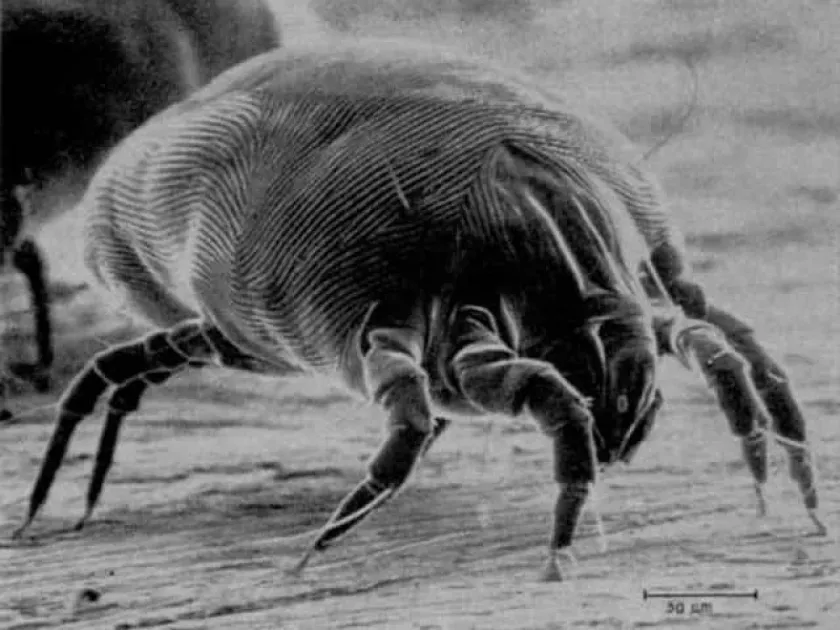
Mayne's house dust mite Euroglyphus maynei is a member of the Pyroglyphidae family within the Acariformes order. It is a microscopic organism, measuring approximately 0.3 mm, rendering it invisible to the naked eye during standard inspections.
The mite possesses an oval-shaped, translucent body, often pale or yellowish in color. Its cuticle is covered in fine striations and microscopic setae, which allow it to adhere to various warehouse surfaces and dust particles.
The life cycle includes the stages of egg, larva, protonymph, tritonymph, and adult. Given ideal conditions, the population can complete its entire life cycle in less than a month, facilitating rapid colonization of suitable environments.
These mites are cosmopolitan and thrive in environments with relative humidity exceeding 60% and temperatures ranging from 20 to 25 degrees Celsius, commonly found in poorly ventilated storage facilities.
They feed primarily on organic detritus, skin scales, and fungal spores. In agricultural settings, they capitalize on the presence of debris in storage areas to maintain their population.
What it damages
Although Euroglyphus maynei does not damage living plants in the field, it is a significant pest of stored agricultural products. It infests warehouses, silos, and storage facilities containing grain, flour, and dried commodities.
The mite acts as a scavenger, feeding on moldy residues and debris found within grain piles. Their activity accelerates the breakdown of stored materials and creates a microenvironment conducive to fungal growth.
Significant infestations lead to the degradation of product quality through contamination with mite feces, shed skins, and dead individuals, rendering the produce unsuitable for processing or sale.
Mite activity often initiates or worsens mold colonization on stored goods, leading to substantial quantitative losses of agricultural commodities during long-term storage.
Furthermore, these mites represent a health hazard for warehouse personnel. Their presence releases allergens into the air, causing respiratory issues for staff handling infected products.
Signs of infestation
A primary indicator of infestation is a distinct, musty odor in the storage area, often caused by high humidity and the presence of micro-organisms associated with the mites.
Visual inspection of hidden areas, such as floor cracks, ventilation ducts, and wall corners, may reveal accumulations of grayish, dusty matter which, under a microscope, confirms the presence of mite colonies.
The appearance of mold patches on walls or packaging is a strong secondary signal that the environmental conditions are favorable for mite proliferation.
Laboratory testing of dust and surface samples is the most accurate method to detect infestation levels, especially in commercial settings where early detection is crucial.
In cases of heavy infestation, shifting or transporting stored grain may release visible clouds of fine debris, indicating a high concentration of mites and their metabolic waste products.
Control measures
The most effective strategy for managing Euroglyphus maynei is strict control of humidity. Keeping the relative humidity of storage facilities below 50% is sufficient to stop reproduction and lead to population decline.
Sanitation is paramount. Regular cleaning of storage areas, removal of dust, and disposal of spilled grain debris are essential to eliminate food sources for the mites.
For established infestations, warehouse fumigation or the application of approved acaricides may be necessary, provided these measures align with safety regulations for food storage facilities.
- Monitor and control ambient humidity levels.
- Regular cleaning and dusting of storage infrastructure.
- Effective sealing of warehouses to prevent moisture ingress.
- Systematic disinfection of storage bins before new intake.
For highly contaminated batches, mechanical cleaning or thermal processing can be employed to manage the mite population and prevent further spread to clean areas.
Taxonomy
- Latin name
- Euroglyphus maynei
- Order
- Mites
- Family
- Pyroglyphidae
- EPPO code
- EURGMA
Discussion
No discussions yet — be the first.