
Dust mite
Dermatophagoides
Description
How to identify
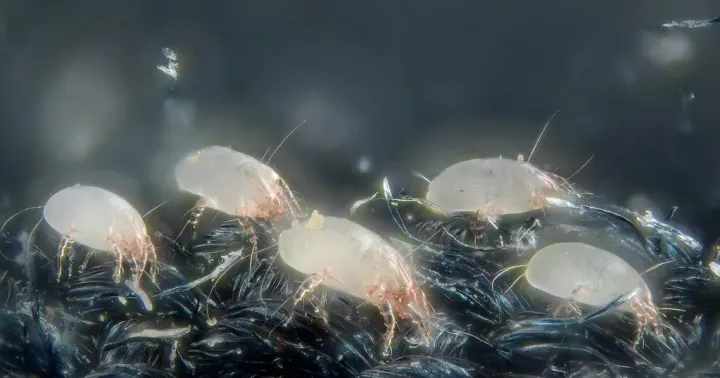
The dust mite (genus Dermatophagoides) belongs to the family Pyroglyphidae, order Sarcoptiformes. It is crucial to clarify that these organisms are not agricultural or horticultural pests.
These are microscopic arthropods, typically measuring about 0.2 to 0.5 mm in length. They have a translucent body and are devoid of any specialized structures to feed on living plant tissue.
As saprophagous organisms, their biology is strictly adapted to consuming organic debris, primarily shed human skin cells. They are obligate synanthropes, meaning they thrive in human-inhabited environments.
Unlike spider mites (Tetranychidae), which possess piercing-sucking mouthparts, dust mites are entirely harmless to botanical specimens. They do not occupy plants as hosts.
In laboratory diagnostics, they are easily distinguishable from plant-feeding mites by their anatomy and the total absence of association with plant damage.
What it damages
Dust mites cause absolutely no damage to plants. They lack the enzymatic and physical ability to digest plant cells or sap. Consequently, they pose no threat to the growth, development, or yield of any crop.
Mistaken reports of dust mite damage often stem from a confusion between different mite species. When plant leaves show symptoms of decline, it is invariably due to other factors such as light deficiency, improper watering, or actual plant-feeding pests.
Accumulated dust on plants can indirectly block stomata and reduce photosynthesis, which is a cleanliness issue rather than a biological infestation by mites.
Horticultural practices should focus on managing actual pests like aphids or spider mites. Applying acaricides intended for plant pests to control dust mites is ineffective and unnecessary.
There is no economic or physiological impact of dust mites on the agricultural industry, as their distribution is limited to indoor domestic or commercial environments.
When it appears
Dust mite populations do not follow seasonal patterns associated with the vegetation cycle of plants. Their activity is dictated by the indoor climate of a building, regardless of the time of year.
They remain active throughout the year under conditions of moderate temperature and high humidity. Unlike outdoor pests, they do not undergo diapause in response to cold weather.
Their life cycle is continuous as long as the environment remains stable. Sudden shifts in indoor conditions, such as dry heating, can decrease their numbers significantly.
In well-managed greenhouses, the lack of human organic debris prevents the establishment of dust mite colonies, meaning they are not a seasonal concern for growers.
Therefore, no seasonal monitoring or spray schedule is required for dust mites in any plant production system.
Signs of infestation
There are no visible signs of dust mite infestation on plants. You will not find lesions, chlorosis, webbing, or distorted growth that could be attributed to this species.
If you see a grey layer on your plants, it is simply dust. This serves as a warning about poor housekeeping rather than a phytosanitary alert for plant pests.
Infestation is verified only through scientific analysis of dust samples using microscopes or molecular tests, which is never necessary for standard plant care.
If you suspect an infestation, check the undersides of leaves for the fine webs characteristic of spider mites, which are the real threat to your collection.
A clean, healthy plant remains unaffected by the presence of dust mites, as it does not provide the food source these organisms require.
Control measures
Control measures for dust mites are entirely sanitary rather than chemical. The use of pesticides against these organisms on or around plants is discouraged, as they are not the target group and it creates unnecessary environmental chemical exposure.
Regular wet cleaning is the most effective prevention strategy. By removing dust, you eliminate the food source of the mites, causing the colony to collapse naturally.
Maintaining relative humidity below 50% effectively inhibits their reproduction. This also benefits the plant’s health by preventing various fungal diseases.
Using vacuum cleaners equipped with high-efficiency particulate air (HEPA) filters is highly recommended for keeping both plant areas and the overall environment clean.
- Implement regular wet surface cleaning
- Use HEPA-filtered vacuum cleaners
- Maintain low indoor humidity
- Ensure proper ventilation
Taxonomy
- Latin name
- Dermatophagoides
- Order
- Mites
- Family
- Pyroglyphidae
- EPPO code
- DERPSP
Discussion
No discussions yet — be the first.