
Seedcorn maggot
Phorbia
Description
How to identify
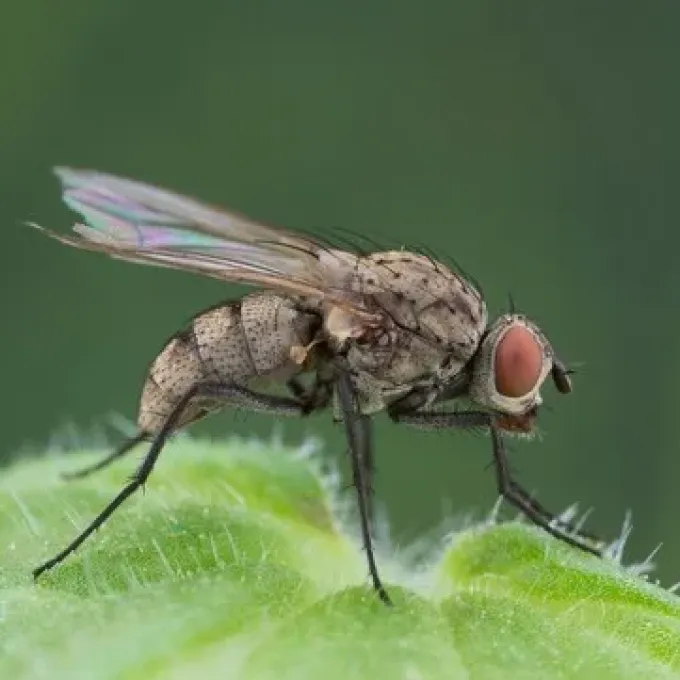
The seedcorn maggot Phorbia platura is a member of the Anthomyiidae family. Adult flies are small, measuring about 4–6 mm in length, with a greyish-brown appearance and distinct dark markings on the thorax.
The larvae, which are the main destructive stage, are legless, white to yellowish-white in color, and reach up to 7 mm in length. They have a tapered body shape, allowing them to burrow easily into seed coats and plant tissues.
The life cycle comprises egg, larva, puparium (overwintering stage in the soil), and adult stages. Depending on the local climate, the insect can complete two to three generations per year.
They overwinter as pupae in the soil at depths of up to 15 cm. In early spring, when soil temperatures rise to 10-12°C, adults emerge, mate, and begin laying eggs in the soil.
Females are attracted to decaying organic matter and freshly tilled soil, where they deposit eggs directly into the earth near germinating seeds or seedlings.
What it damages
The seedcorn maggot is a significant polyphagous pest, attacking a wide range of crops including corn, soybeans, beans, peas, cucurbits (cucumbers, melons), and sugar beets.
Larvae cause the most damage by feeding on germinating seeds before emergence. This destroys the embryo and leads to poor plant stands or total crop failure, often necessitating reseeding.
Later generations may attack the roots and stems of older plants, causing stunted growth, wilting, and eventually plant death, especially in wet or cold conditions that delay plant emergence.
The pest is particularly severe during cool, wet springs. In such conditions, seeds take longer to germinate, remaining in the "danger zone" where maggots are highly active for a longer duration.
Damaged plant tissues serve as entry points for various soil-borne pathogens, including bacteria and fungi, which can cause secondary rots and further degrade the health of the crop.
When it appears
The activity of the seedcorn maggot begins in early spring, synchronized with the start of planting season. This overlap is why early-planted crops are frequently hit hardest.
The emergence of adults occurs over several weeks. Females seek out fields with high levels of organic matter or those that have recently been turned, making these areas high-risk zones.
In mid-summer, while the pressure may slightly decrease for certain crops, the pest remains active, particularly in vegetable production areas where multiple generations can overlap.
Soil moisture plays a crucial role in population dynamics; high moisture levels generally favor the survival and development of the larvae throughout their development cycle.
After the larval stage is complete, they move deeper into the soil to pupate, emerging as a new generation of flies that continue the infestation cycle on neighboring crops.
Signs of infestation
The primary sign of infestation is patchy or uneven crop emergence. If you observe significant gaps in the rows, it is highly likely that seeds were destroyed by maggots underground.
Excavating the soil in affected areas often reveals seeds that have been hollowed out or are covered in white larvae. These seeds usually smell foul due to rot and pest activity.
In emerged seedlings, signs include sudden yellowing and wilting of the youngest leaves. If the plant is pulled, the base of the stem or root system may show signs of burrowing or feeding.
For crops like cucumbers or beans, larvae may penetrate the hypocotyl, causing the seedling to break at the soil line, leading to rapid wilting and plant death.
The presence of small, irregular holes in the cotyledons or stems of newly emerged seedlings is another indicator of early larval feeding activity.
Control measures
The most effective strategy is cultural control: planting when soil conditions are ideal for rapid germination. Fast-growing plants quickly move past the most vulnerable developmental stages.
Avoid planting immediately after incorporating heavy amounts of organic matter, such as raw manure, as the decomposing material attracts egg-laying females.
- Use deep tillage in the fall to bury pupae and disrupt their development.
- Utilize high-quality, insecticidal-treated seeds to provide protection during the critical emergence window.
- Maintain weed-free fields to reduce potential habitats for adult flies.
- Apply fertilizers appropriately to ensure vigorous, uniform plant growth.
In high-risk areas, the use of systemic insecticidal seed treatments is the standard and most reliable method to protect crops from significant stand loss.
Taxonomy
- Latin name
- Phorbia
- Order
- Diptera (flies)
- Family
- Anthomyiidae
- EPPO code
- PHBISP
Discussion
No discussions yet — be the first.