
Beet leaf miner
Pegomya nigritarsis
Description
How to identify
The Beet leaf miner (Pegomya nigritarsis) is a dipteran insect belonging to the Anthomyiidae family. The adult fly is typically grey, measuring between 5 and 7 mm in length.
The eggs are small, whitish, and elongated with a characteristic reticulated surface. They are laid in small groups, usually on the undersides of leaves.
The larvae are legless, reaching 7–8 mm when mature. Their color ranges from translucent white to yellowish, with a tapered body structure adapted for tunneling through leaf tissue.
Pupation occurs in a barrel-shaped, brown puparium. This is the stage in which the insect typically overwinters, buried in the soil or within plant debris.
The life cycle is temperature-dependent, allowing for multiple generations per year, which significantly increases the risk of damage during the growing season.
What it damages
This pest primarily attacks plants in the Amaranthaceae family, with sugar beet, table beet, and mangelwurzel being the main economic hosts.
Weeds such as lamb's quarters (Chenopodium album) act as alternative hosts, supporting the pest population when primary crops are not available.
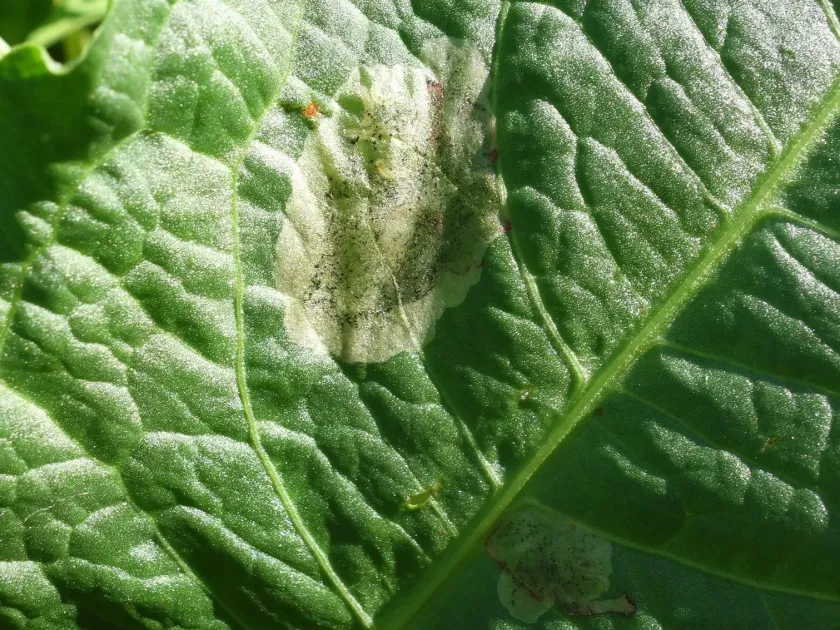
Larvae feed by creating mines within the leaf blade. They consume the internal leaf tissue (parenchyma) while leaving the upper and lower epidermis intact.
These mines disrupt photosynthesis, reduce the overall leaf surface area, and can lead to severe stress for the plant, especially at the seedling stage.
Significant infestations can lead to stunted root growth and a reduction in sugar content in sugar beets, impacting the final harvest yield.
When it appears
The first generation of adults emerges in early spring, as soon as soil temperatures reach approximately 10–12 degrees Celsius.
Adults are most active during the cooler parts of the day, as they are sensitive to high solar radiation and extreme heat.
Peak larval activity occurs from late spring through mid-summer, coinciding with the most rapid vegetative growth phase of the beet plants.
Subsequent generations follow throughout the summer months, with the last generation preparing to enter the pupal stage for the winter.
Weather conditions, particularly rainfall and humidity, play a crucial role in the survival rate of the larvae and the timing of emergence.
Signs of infestation
The first visual signs of infestation include small, light-colored spots on the leaves that gradually expand into irregular, blotchy mines.
Close inspection of the underside of the leaf often reveals clusters of white, oval eggs deposited near the midrib.
Within the mines, one can often see dark frass (excrement) pellets left behind by the larvae as they feed inside the leaf tissue.
As the damage progresses, the affected leaf areas turn brown and necrotic, eventually causing the entire leaf to curl, wither, and die.
Heavily infested fields appear unhealthy and patchy, with visible yellowing and chlorosis that severely affects the plant's overall vigor.
Control measures
Deep plowing in the autumn is a fundamental cultural practice, as it buries puparia deep enough to prevent adult emergence in the following spring.
Effective weed management, specifically targeting Chenopodium and other host species, is essential to reduce the pest's reservoir populations.
Crop rotation should be strictly implemented to avoid planting beets in fields that were infested in previous years.
Chemical control involving insecticides is effective if applied early, during the peak egg-laying period, before larvae establish themselves within the leaves.
- Systemic insecticides are generally preferred for better efficacy within leaf tissues.
- Timing of sprays should be based on economic threshold levels and field scouting.
- Use yellow sticky cards for monitoring adult flight activity to plan treatment windows.
Taxonomy
- Latin name
- Pegomya nigritarsis
- Order
- Diptera (flies)
- Family
- Anthomyiidae
- EPPO code
- PEGONI
Discussion
No discussions yet — be the first.