
Dock fly
Pegomya bicolor
Description
How to identify
The dock fly (Pegomya bicolor) is a member of the Anthomyiidae family within the order Diptera. It is a small, grayish-brown insect that resembles a common housefly in appearance.
Adult flies measure approximately 5 to 6 millimeters in length and possess transparent wings. They are agile insects typically active during warm daylight hours.
The larva is an apodous (legless), elongated, and creamy-white maggot reaching up to 8 millimeters when mature. It lives and feeds entirely within the leaf tissue.
The life cycle encompasses four stages: egg, larva, pupa, and adult. The insect typically overwinters as a puparium in the soil at a shallow depth.
In spring, adult flies emerge, and females begin laying eggs on the undersides of young sorrel leaves to initiate the new generation.
What it damages
The primary host plants for the dock fly are species of Rumex (sorrel and dock), although it can occasionally infest rhubarb and certain related weeds.
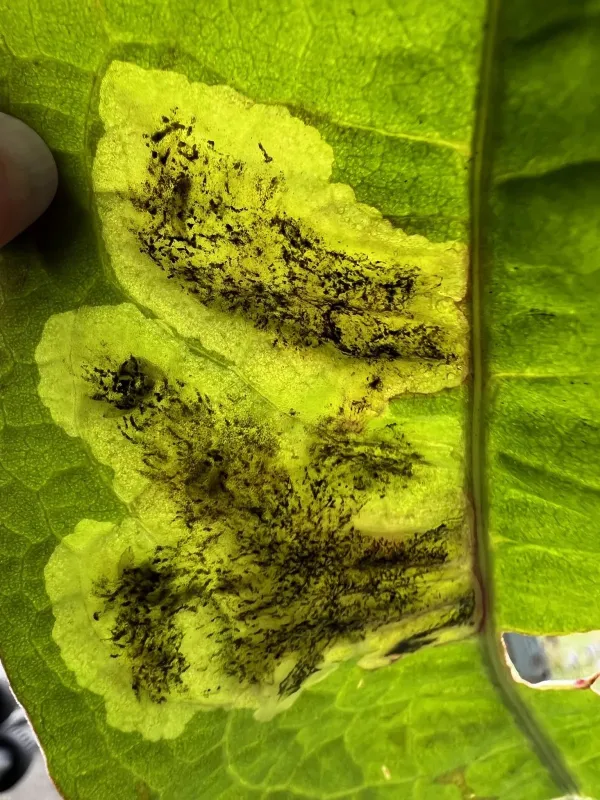
Larvae feed on the leaf mesophyll, creating distinctive mines that appear as irregular or winding blotches between the upper and lower leaf surfaces.
Feeding damage reduces the photosynthetic area of the leaf, which leads to stunted plant growth and decreased yield of the crop.
Beyond physical damage, the presence of larvae and their frass (excrement) inside the leaves renders the sorrel completely unsuitable for human consumption.
Severe infestations cause leaves to yellow, wither, and eventually die, significantly weakening the plant's root system over time.
When it appears
The first emergence of adults typically occurs in late spring, coinciding with the rapid growth of tender sorrel leaves in May.
The insect produces multiple generations throughout the growing season, which allows the population to multiply rapidly under favorable weather conditions.
The first generation is usually the most damaging, as it targets the earliest spring harvests, which are the most valuable for fresh consumption.
During the peak of summer, warmer temperatures accelerate the developmental stages from egg to adult, leading to constant pressure on the crops.
As temperatures begin to drop in late autumn, the final larval stages descend into the soil to pupate and remain dormant until the following spring.
Signs of infestation
The most recognizable sign is the presence of pale, blister-like mines on the leaf surface that turn brown as the tissue dies.
When observing a leaf against the light, one can see the tunnels created by the mining larvae and small dark particles of their waste.
Heavily infested leaves often become distorted, curled, or brittle, and may lose their characteristic green color, showing signs of premature senescence.
Multiple mines can merge into large necrotic patches that eventually compromise the integrity of the entire leaf blade.
- Presence of winding or blotch-like mines on foliage.
- Yellowing and browning of affected leaf areas.
- Visible larvae or frass within the leaf tissue.
- Premature shriveling and curling of sorrel leaves.
Control measures
The most effective management technique is the regular and thorough harvesting of sorrel leaves, which removes the larvae before they can pupate.
Cultivation of the soil between rows in late autumn is a crucial step to disturb and destroy the puparia overwintering in the upper soil layers.
Sanitation practices, such as removing host weeds like wild dock or lamb's quarters, help eliminate secondary reservoirs of the pest.
If chemical control is necessary, it is vital to select pesticides that are approved for use on leafy greens and strictly adhere to pre-harvest intervals.
Biological control methods, such as encouraging natural predators, can also play a role in maintaining lower pest population densities.
Taxonomy
- Latin name
- Pegomya bicolor
- Order
- Diptera (flies)
- Family
- Anthomyiidae
- EPPO code
- PEGOBI
Discussion
No discussions yet — be the first.